
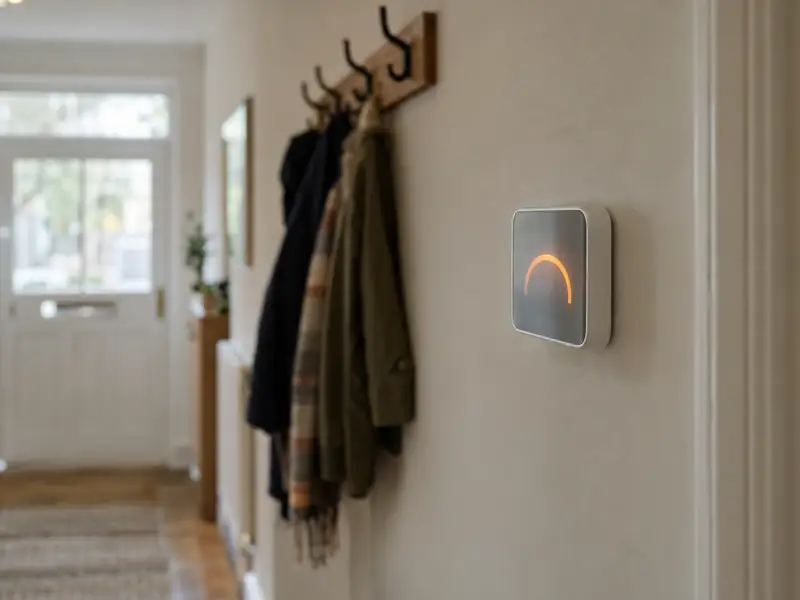
Heat pump controls are the settings and devices that decide how warm the water in your heating is, when the heat pump runs and when it heats hot water. The most important is weather compensation, which raises the flow temperature gradually as it gets colder outside and lowers it in milder weather, so the system only ever runs as warm as it needs to.
If an existing heat pump in Buckinghamshire feels costly to run, a controls check is often the first thing to look at. Homeowners in Buckinghamshire get a walkthrough of their controls at handover, with a simple written guide to keep. For Buckinghamshire homes with extensions, we plan zones so the new space heats properly without making the heat pump cycle.
Who it suits
- Households considering a heat pump or time-of-use electricity tariff
- Existing heat pumps that feel expensive to run or slow to respond
- Homes with solar PV or a battery that want hot water timed to match
- Homes with an extension, loft room or areas heated at different times
Grants and rules for heat pumps in England
Homes in Buckinghamshire can use the Boiler Upgrade Scheme, which takes £7,500 off the cost of an air source heat pump when it replaces fossil-fuel or electric heating. Replacing oil or LPG heating qualifies for £9,000 for installations from 21 July 2026 to 31 March 2027, and air-to-air systems for £2,500. The MCS-certified installer named in your quote applies for the grant and deducts it from the price.
There is no VAT on installing a heat pump anywhere in the UK until 31 March 2027. In England most houses can have an air source heat pump under permitted development, provided the unit meets the MCS noise and siting standards; the old 1 m boundary limit was removed on 29 May 2025. We flag listed buildings, flats and sensitive conservation-area positions at survey.
Prices
Weather-compensating controls and set-up are included in every full system price. See the guide prices for full systems.
Towns we cover in Buckinghamshire
We cover 13 towns in Buckinghamshire for heat pump controls and tariffs. Each links to local guide prices and the grant position for England.
| Town | Postcode district | Nearest town | Midwinter daylight |
|---|---|---|---|
| Milton Keynes | MK9 | Bletchley | 7 h 44 min |
| High Wycombe | HP11 | Marlow | 7 h 48 min |
| Aylesbury | HP20 | Princes Risborough | 7 h 46 min |
| Bletchley | MK2 | Milton Keynes | 7 h 44 min |
| Amersham | HP7 | Chesham | 7 h 48 min |
| Chesham | HP5 | Amersham | 7 h 48 min |
| Gerrards Cross | SL9 | Chalfont St Peter | 7 h 49 min |
| Chalfont St Peter | SL9 | Gerrards Cross | 7 h 48 min |
| Marlow | SL7 | High Wycombe | 7 h 49 min |
| Beaconsfield | HP9 | Chalfont St Peter | 7 h 48 min |
| Buckingham | MK18 | Brackley | 7 h 44 min |
| Olney | MK46 | Milton Keynes | 7 h 43 min |
| Princes Risborough | HP27 | Aylesbury | 7 h 47 min |
Heat pump controls and tariffs questions
Why are my radiators only warm, not hot?
That is normal for a heat pump. It heats radiators to a lower temperature than a boiler, so they feel warm rather than hot to the touch, while running longer to keep the room at a steady temperature. If rooms reach the temperature you set, the system is working as designed. If a room stays cold, the settings or radiator size may need checking.
Should I turn my heat pump off at night?
Usually not. Switching off lets the house cool, and the heat pump then has to run at a higher flow temperature to recover, which lowers efficiency. A small set-back of 1–2°C overnight is generally more economical. Homes with very good insulation or a time-of-use tariff may suit different patterns, which we can set up.
How should I set the hot water on a heat pump?
Most households heat hot water once or twice a day at set times rather than on demand. Timing the main heat for a cheaper tariff period, or for the middle of the day when solar panels generate, helps keep costs down. A weekly legionella cycle raises the water temperature higher, and we schedule it at a sensible time.
What flow temperature should my heat pump run at?
It depends on the design: the flow temperature is set so your radiators or underfloor heating can heat each room on a cold day. Well-designed systems typically run at around 35–50°C at their coldest, and lower in milder weather through weather compensation. Your design paperwork states the design flow temperature, and we set the heating curve to match it.