
- Guide price
- From £9,500 inc VAT
- Survey
- Free home survey for installation enquiries
- Coverage
- England, Wales, Scotland and Northern Ireland
A split system heat pump is an air-to-water heat pump in two parts: an outdoor unit that collects heat from the air, and an indoor unit called a hydrobox where that heat is passed into the water for your heating and hot water. The two are connected by insulated refrigerant pipes rather than water pipes, so there is no water outside to freeze.
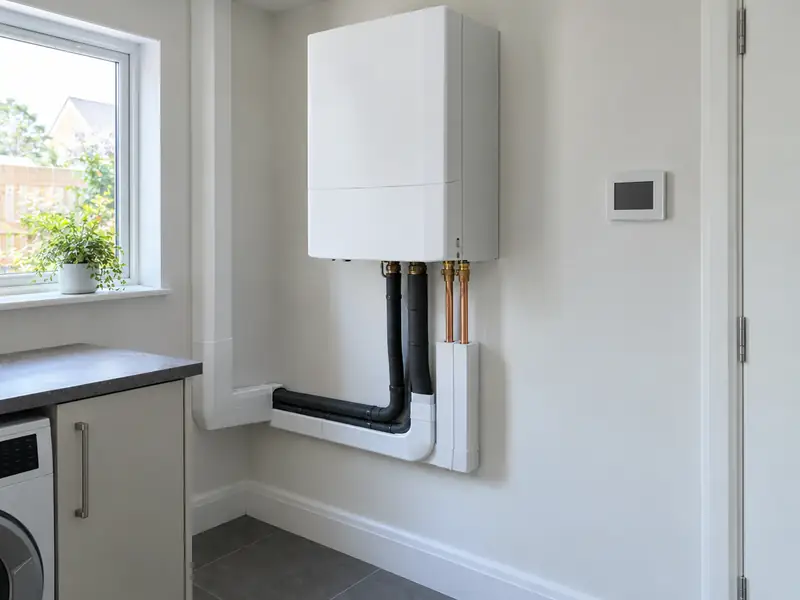
The hydrobox is a wall-mounted cabinet roughly the size of a boiler, or it can be built into a combined cylinder unit. It holds the heat exchanger, circulating pump, valves and controls. Outdoor units for split systems can be more compact than monobloc units of similar output, which helps where outdoor space is limited.
Because the refrigerant pipes are joined and charged on site, and split systems usually use a fluorinated refrigerant such as R32, the refrigerant work must by law be done by an F-gas certified engineer. That makes installation a little more involved than a monobloc, and any later repair to the refrigerant circuit also needs F-gas certified work. In return, a split system copes better with long or awkward routes between the outdoor unit and the house, within the limits the manufacturer sets.
Who it suits
- Homes where the outdoor unit must sit some distance from the plant space
- Exposed or frost-prone sites where outdoor water pipes would be a risk
- Small yards, roofs or balconies that suit a more compact outdoor unit
- Houses with indoor wall space for a boiler-sized hydrobox
- Owners who would rather not use glycol or anti-freeze valves
Things to consider
- Refrigerant work must be done by an F-gas certified engineer, at installation and for any later repair to the refrigerant circuit.
- The hydrobox needs indoor wall space as well as the cylinder.
- Refrigerant pipe length and height difference are limited by the manufacturer.
- Depending on the refrigerant charge, periodic leak checks may be required.
When does a split system make more sense than a monobloc?
A split system tends to suit homes where the outdoor unit cannot sit close to the plant space, or where outdoor water pipes would be exposed to frost. Refrigerant lines can run further and through tighter routes than insulated water pipes, and there is no water outside to protect. Typical cases:
- The only good unit position is on the far side of the house or on a flat roof
- The pipe route crosses an exposed area, such as a long side wall or a detached garage
- Outdoor space is tight and a compact unit fits better
- You would rather avoid glycol or anti-freeze valves
Where none of these apply, a monobloc is usually simpler. The survey compares both options for your home.
What is a hydrobox and where does it go?
The hydrobox is the indoor half of a split system, where heat from the refrigerant is transferred into the water circuit. It is usually a wall-mounted cabinet about the size of a boiler, containing the plate heat exchanger, pump, valves, expansion vessel and often the main controller.
It is normally fitted near the cylinder, in a utility room, garage or cupboard, with space around it for servicing. Some manufacturers offer integrated units that combine the hydrobox and cylinder in one tall cabinet, which can tidy up a plant cupboard.
What does the F-gas requirement mean for me?
F-gas rules require anyone installing, servicing or repairing the refrigerant circuit to be an F-gas certified engineer. On a split system that covers joining and pressure-testing the refrigerant pipes, evacuating them and charging the system, so it is planned into the installation team.
For you, it means later refrigerant repairs must also be done by an F-gas certified engineer, and some systems need periodic leak checks depending on the refrigerant charge. Split systems are commonly charged with R32.
How is a split system installed?
A typical installation takes 2–4 days on site. The outdoor unit is set on its base or brackets, then refrigerant pipes and a communication cable are run to the hydrobox inside. The F-gas certified engineer makes the joints, pressure tests the pipework, evacuates it and adds refrigerant as needed for the pipe length, before the water side is filled and commissioned.
Full systems have a guide price from £9,500, installed and including VAT, with your final price fixed in a written quote after the survey.
What's included
- Free survey comparing split and monobloc options for your home
- Outdoor unit, indoor hydrobox and heat pump cylinder
- Refrigerant pipework and charging by an F-gas certified engineer
- Water-side connections, controls and weather compensation
- Commissioning with pressure and leak test records
- MCS registration, with the grant claimed in England and Wales if you qualify
Split system heat pumps guide prices
| Home | Typical size | Installed guide price | After £7,500 grant |
|---|---|---|---|
| 1–2 bedroom flat or small terrace | 4–5 kW | £9,500–£12,500 | £2,000–£5,000 |
| 2–3 bedroom terrace or semi | 5–7 kW | £10,500–£13,500 | £3,000–£6,000 |
| 3 bedroom semi or small detached | 6–9 kW | £12,000–£15,500 | £4,500–£8,000 |
| 4 bedroom detached | 8–12 kW | £14,000–£18,000 | £6,500–£10,500 |
| 5+ bedroom or larger older house | 11–16 kW | £16,500–£22,500 | £9,000–£15,000 |
Installed, inc VAT: unit, cylinder, controls, minor pipework and commissioning.
Split system heat pumps questions
Is a split system more efficient than a monobloc?
Not inherently. Efficiency depends far more on design, meaning correct sizing, low flow temperatures and good controls, than on whether the unit is split or monobloc. A split system can avoid the heat loss and glycol of a long outdoor water run, which helps in certain layouts. The survey estimates seasonal efficiency for the specific units proposed, so you can compare like for like.
Do I need an F-gas engineer for a split heat pump?
Yes. Split systems usually use a fluorinated refrigerant such as R32, so installing, servicing or repairing the refrigerant circuit must by law be done by an F-gas certified engineer. That covers joining the refrigerant pipes, testing them for leaks and charging the system. Your quote sets out who carries out each part of the installation, including the refrigerant work.
How big is a hydrobox?
A hydrobox is typically about the size of a wall-mounted boiler, though sizes vary by make and model. It needs wall space near the cylinder with room around it for servicing and pipe connections. Some manufacturers combine the hydrobox and cylinder in a single floor-standing unit similar in size to a tall fridge-freezer, which can suit a utility room or garage.
Can a split system replace my combi boiler?
Yes, but like any air-to-water heat pump it needs a hot water cylinder, because it does not heat water instantly. The hydrobox can sometimes go where the combi was, with the cylinder in a cupboard, utility room or garage. Integrated units combining both are useful where one larger space is available. The survey checks what fits before the design is finalised.
Is a split system eligible for the Boiler Upgrade Scheme?
Yes. A split air-to-water heat pump counts as an air source heat pump under the scheme, so in England and Wales eligible owners of existing homes can receive £7,500, or £9,000 when replacing oil or LPG within the published dates. The MCS-certified installer applies for you. Scotland's Home Energy Scotland funding is separate, and Northern Ireland has no dedicated homeowner grant at present.
How far apart can the outdoor unit and hydrobox be?
It depends on the model: each manufacturer sets a maximum refrigerant pipe length and height difference, and longer runs may need extra refrigerant. In practice a split system allows more flexibility than a monobloc's water pipes, so the outdoor unit can often sit on the far side of a house, on a flat roof or round a corner. The survey measures the actual route.