
- Guide price
- From £6,000 inc VAT
- Visit
- Visit rate agreed in advance
- Coverage
- England, Wales, Scotland and Northern Ireland
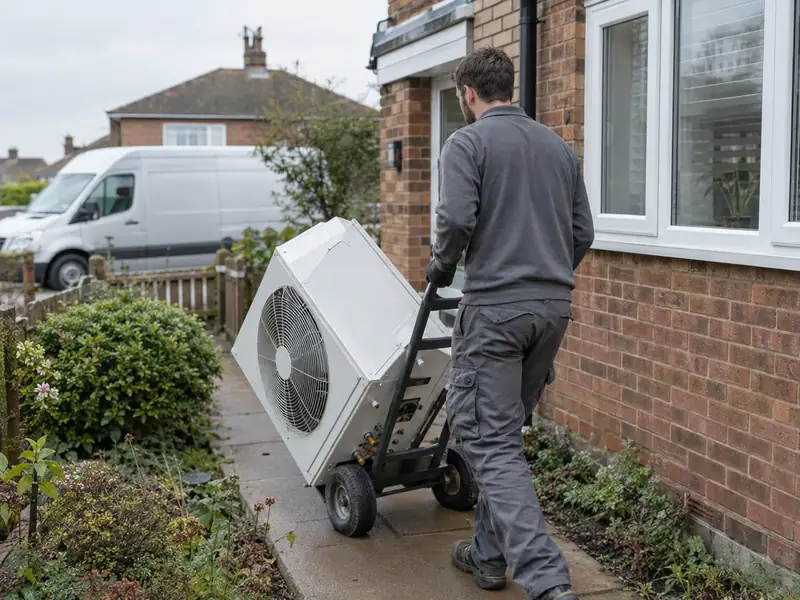
Heat pump replacement means removing an existing outdoor unit, and sometimes the cylinder and controls, and fitting a new heat pump sized and set up for the home as it is now. Air source heat pumps typically last 15–20 years, so systems fitted when the technology was newer to UK homes are reaching the point where repairs become harder to justify.
Not every replacement is about age. Some heat pumps were sized by rule of thumb, paired with radiators that are too small or set up without weather compensation, leaving homes cold or bills high. Replacing the unit alone will not fix those problems, so we start with a fresh heat loss survey and check the radiators, pipework, cylinder and controls.
Replacing an old outdoor unit like-for-like has a guide price of £6,000–£9,500, installed and including VAT. Where the system needs re-sizing or other upgrades, the written quote sets out each item. Grant funding rarely applies to replacements, because the Boiler Upgrade Scheme in England and Wales cannot usually fund a home already funded for a heat pump, so we check eligibility before quoting.
Who it suits
- Heat pumps nearing the end of their typical life with rising repair costs
- Units that have failed with a major fault, such as a compressor failure
- Systems that were undersized and struggle in cold weather
- Oversized systems that short cycle and cost more to run than expected
- Older units where parts are becoming hard to source
Things to consider
- A like-for-like swap is quicker, but repeating a poor design repeats the same problems.
- A larger or different unit may need a new position, base, electrical supply or noise check.
- Grant funding rarely applies when replacing a heat pump; we check eligibility for your home.
- Radiator or pipework upgrades may be needed if the original design ran too hot.
- Some older cylinders and controls are not compatible with a new heat pump and need replacing too.
Should I repair or replace my heat pump?
Replacing usually makes more sense than repairing when the unit is near the end of its typical 15–20 year life, when a major component such as the compressor has failed, or when parts are no longer available. A repair is usually the better choice for a younger unit with a single failed part, such as a sensor, pump or fan motor.
We look at the age, condition and repair history of the unit, the cost of the repair against a replacement, and whether the system performs well when it is working. If the home was never warm enough, a properly designed replacement is often the better use of money than another repair.
Can you fix an undersized or poorly designed system?
Yes, an undersized or poorly designed system can usually be put right by re-sizing the heat pump and correcting the parts of the design that hold it back.
- Undersized units run flat out in cold weather and lean on backup heaters; a fresh heat loss calculation sets the correct size.
- Oversized units short cycle and lose efficiency; a better-matched unit can run longer and steadier.
- Small radiators force a high flow temperature; upgrading key rooms lets the system run cooler.
- Missing controls, such as weather compensation, are added and set up properly.
Sometimes the unit is the right size and only the radiators, pipework or settings need changing, in which case we say so rather than replacing a working heat pump.
What changes with newer heat pumps?
Newer heat pumps typically use refrigerants with a lower environmental impact, mainly R32 and R290 (propane), and many offer better efficiency and higher water temperatures than units from ten or more years ago, while being designed to run quietly. R290 units can often reach higher flow temperatures, which can help in homes where some radiators cannot be changed.
Modern controllers also tend to include weather compensation, energy monitoring and app control as standard. A new unit may be a different size or shape from the old one, so the base, position, pipe connections and noise check are confirmed at survey.
Will a grant cover a replacement heat pump?
A grant is unlikely to cover a replacement heat pump. The Boiler Upgrade Scheme in England and Wales cannot usually fund a home that has already been funded for a heat pump, and it is aimed at homes moving from fossil-fuel or electric heating, so most replacements are paid for in full. Eligibility depends on your home's history, so we check it before quoting.
In Scotland, check Home Energy Scotland's current criteria for replacements before planning around funding. Northern Ireland has no dedicated heat pump grant for homeowners at present.
What's included
- Fresh room-by-room heat loss survey before any unit is chosen
- Assessment of the existing radiators, pipework, cylinder and controls
- Removal of the old outdoor unit, with refrigerant recovered by an F-gas certified engineer
- Supply and installation of the new heat pump, base and connections
- Control setup with weather compensation and hot water scheduling
- Electrical checks and network operator notification where required
- Commissioning, MCS registration and certificate, and handover
Heat pump replacement guide prices
| Work | Installed guide price |
|---|---|
| Replacing an old outdoor unit like-for-like | £6,000–£9,500 |
| Full system replacement, 2–3 bedroom terrace or semi | £10,500–£13,500 |
| Full system replacement, 3 bedroom semi or small detached | £12,000–£15,500 |
| Full system replacement, 4 bedroom detached | £14,000–£18,000 |
Installed, inc VAT. Grant funding rarely applies to replacing a heat pump, so these prices are shown without any deduction; we check eligibility at survey.
Heat pump replacement questions
How long does an air source heat pump last?
Air source heat pumps typically last 15–20 years, depending on the quality of the original design, how hard the unit has worked, where it is sited and how well it has been serviced. Units that short cycle or run at high flow temperatures for years may wear sooner. Annual servicing helps components last and spots problems early.
How much does it cost to replace a heat pump?
Replacing an old outdoor unit like-for-like has a guide price of £6,000–£9,500, installed and including VAT. Re-sizing, a new cylinder, radiator upgrades or new controls add to that, and each is itemised in your written quote. The final price is fixed after a survey, once we know what the existing system needs.
Can I get a grant to replace my heat pump?
Usually not. In England and Wales, the Boiler Upgrade Scheme cannot normally fund a home that has already been funded for a heat pump, and it is aimed at replacing fossil-fuel or electric heating. Your circumstances may differ, so we check eligibility before quoting. In Scotland, check Home Energy Scotland's criteria. Northern Ireland has no dedicated grant at present.
Can I replace just the outdoor unit?
Often, yes, if the rest of the system is sound and correctly designed. The cylinder, controls and radiators can stay where they are compatible with the new unit. Some older cylinders and controllers do not work with a new heat pump, and the survey checks this. If the original design was the problem, replacing only the unit will not fix it.
Will a new heat pump fit where the old one was?
Sometimes. A new unit may be a different size, weight or shape and may have different clearance requirements, so the existing base and position are checked at survey. The MCS noise assessment is carried out for the new unit, and a different position may be suggested if it improves performance or reduces sound at neighbouring windows.
What happens to my old heat pump?
The old outdoor unit is removed and disposed of responsibly. Its refrigerant is recovered first, which must be done by an F-gas certified engineer, and metals and components are recycled where facilities allow. If the old cylinder or controls are replaced too, they are removed at the same time, and pipework that is no longer needed is capped or taken out.