
- Guide price
- From £250 inc VAT
- Survey
- Free home survey for installation enquiries
- Coverage
- England, Wales, Scotland and Northern Ireland
A heat pump radiator upgrade means replacing only the radiators that are too small to heat their room at the lower water temperatures a heat pump runs at. A gas boiler usually sends water to radiators at 60–75°C, while a well-designed heat pump system typically runs at around 35–50°C. Cooler water gives out less heat from the same radiator, so some rooms need more radiator surface to stay comfortable.
The good news is that many homes keep most of their existing radiators. Older houses were often fitted with radiators larger than they needed, and rooms that have since been insulated may now need less heat. The only way to know is a room-by-room calculation: the heat loss survey works out how much heat each room loses on a cold day and checks whether the radiator already there can deliver it at the chosen flow temperature.
Where a radiator falls short, the usual fix is a larger panel radiator, a double or triple-panel model in the same space, or a fan-assisted radiator where wall space is tight. We also check the pipework feeding each radiator, because narrow pipes can restrict the higher water flow rates heat pumps rely on. Everything is listed in a radiator schedule in your quote, so you can see exactly which radiators change and why.
Who it suits
- Homes switching from a gas, oil or LPG boiler to a heat pump
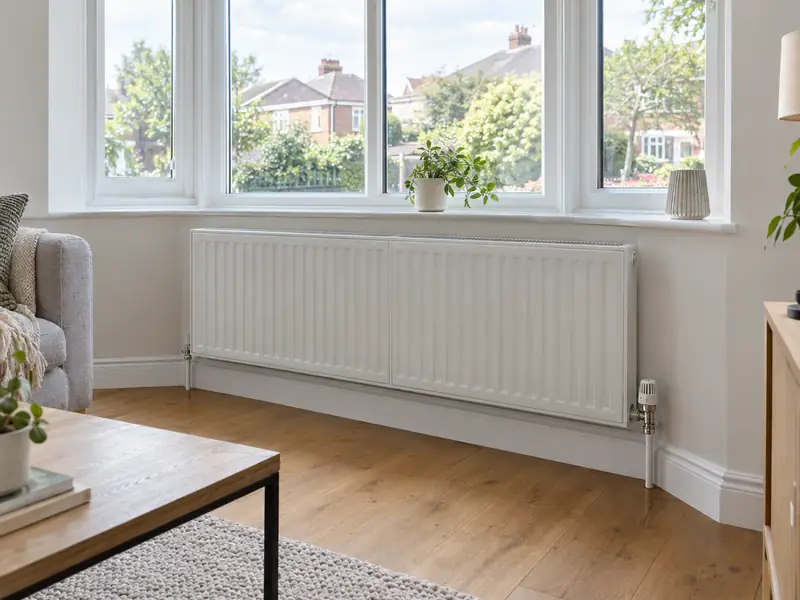
- Rooms that already feel slow to heat, such as bay-windowed living rooms
- Extensions and loft conversions with large areas of glazing
- Homeowners who want the lowest practical flow temperature for efficiency
- Rooms with little wall space, where a fan-assisted radiator fits better
Things to consider
- Some new radiators will be larger or deeper than the ones they replace, which can affect where furniture goes.
- Changing microbore pipework means lifting some floorboards or chasing walls, and adds time and cost.
- Fan-assisted radiators need an electrical supply and make a low fan sound while running at higher output.
- Redecorating behind new radiators is easiest to plan before installation day.
- Keeping an undersized radiator usually means running the whole system hotter, which lowers efficiency.
Why does a heat pump need bigger radiators?
A heat pump needs bigger radiators in some rooms because it heats water to a lower temperature than a boiler, and a radiator's output falls as its water temperature falls. Radiator outputs are usually catalogued at a 50°C difference between the average water temperature and the room, known as delta T 50. At typical heat pump temperatures that difference may be 25–30°C, and the same radiator can give out roughly half its catalogued output or less.
Running the heat pump hotter to make small radiators work is possible, but each extra degree of flow temperature lowers efficiency. Sizing the radiators to the room lets the system run low and steady, which is how heat pumps are designed to work.
Which rooms usually need a new radiator?
The rooms most likely to need an upgrade are the ones that lose the most heat for their size.
- Living rooms with bay windows, patio doors or an open fireplace
- Rooms with high ceilings or two or more outside walls
- North-facing rooms and rooms above an unheated garage
- Extensions and kitchen-diners with large glazed areas or rooflights
- Bathrooms, where a towel rail alone rarely matches the heat needed at low temperatures
Bedrooms are often fine as they are, because they are kept cooler and the existing radiators may already be generous. Hallways vary: a draughty front door can make a small hall radiator the weak point of the whole design.
What types of radiator work with a heat pump?
Any wet radiator works with a heat pump if it is large enough for the room at the design flow temperature.
- Double-panel radiators (two panels with fins) give much more heat than a single panel of the same height and width.
- Triple-panel radiators add a third panel for more output where wall space is short, at the cost of extra depth.
- Fan-assisted radiators use small low-energy fans to push air across the fins, raising output from a compact unit.
- Column radiators suit period homes and can be made larger by adding sections.
Designer and aluminium radiators can work too, but their output at low temperatures must be checked against the manufacturer's data rather than the headline figure.
Will my pipework need changing?
Pipework may need changing if radiators are fed by microbore pipe, typically 8 or 10 mm, because heat pumps circulate more water than boilers at a smaller temperature difference. Narrow pipes can restrict that flow, causing noise and rooms that never quite warm up. Standard 15 mm and 22 mm pipework is usually suitable, though the main runs near the heat pump may need upsizing.
The surveyor checks pipe sizes where they can be seen and plans any changes to keep disruption down, often by running new pipes under floors or through cupboards. A pipework upgrade has a guide price of £1,500–£3,500, installed and including VAT.
What's included
- Room-by-room heat loss figures for every heated room
- A radiator schedule showing which radiators stay, which change and their outputs
- Supply and fitting of new radiators, valves and brackets
- Pipework checks and any agreed pipe upgrades
- Draining, refilling, cleaning and inhibitor treatment of the heating system
- Balancing every radiator so each room heats evenly
- Making good around brackets and pipe routes, with any decorating agreed in your quote
Heat pump radiators guide prices
| Work | Guide price |
|---|---|
| Replacement radiator, sized for a heat pump (each, fitted) | £250–£450 |
| Upgrade of about 10 radiators | £2,000–£5,000 |
| Pipework upgrade (e.g. microbore to larger bore) | £1,500–£3,500 |
Installed, inc VAT. The survey lists which radiators need changing.
Heat pump radiator upgrades questions
Do I need new radiators for a heat pump?
Not necessarily: many homes keep most of their radiators and replace only a few. The heat loss survey checks each room against its existing radiator at the planned flow temperature. Rooms with large windows, high ceilings or extensions are the usual candidates for an upgrade, while bedrooms often need no change. Your radiator schedule lists every decision.
How much does a heat pump radiator cost?
A replacement radiator sized for a heat pump has a guide price of £250–£450 each, installed and including VAT. Upgrading about ten radiators in a typical home has a guide price of £2,000–£5,000. The final price is fixed in your written quote after the survey, once the radiator schedule shows exactly which radiators change.
Can I keep my radiators and just run the heat pump hotter?
You can, but it usually costs more to run. Every extra degree of flow temperature reduces a heat pump's efficiency, so a system designed at 55°C uses noticeably more electricity than one at 45°C for the same heat. A few well-chosen radiator upgrades often let the whole house run cooler, which is the better long-term trade.
Are fan-assisted radiators noisy?
Fan-assisted radiators make a low, steady fan sound when running at higher output, and many have quieter settings for bedrooms at night. They are useful where wall space is short, such as a kitchen with few clear walls. They need a small electrical supply, which we plan into the installation if you choose them.
Will new radiators be much bigger than my old ones?
Sometimes, but not always. Swapping a single-panel radiator for a double or triple-panel model of the same height and width can raise output substantially, adding only depth from the wall. Where that is not enough, a longer or taller radiator, or a second radiator in the room, may be needed. We agree sizes and positions with you before anything is ordered.
Can radiators be changed without draining the whole system?
Radiator changes normally mean draining the heating system, which is why they are usually done as part of the heat pump installation. The system is then refilled, flushed, treated with inhibitor and balanced. Doing the radiators at the same time avoids draining twice and means the new radiators are commissioned with the heat pump.