
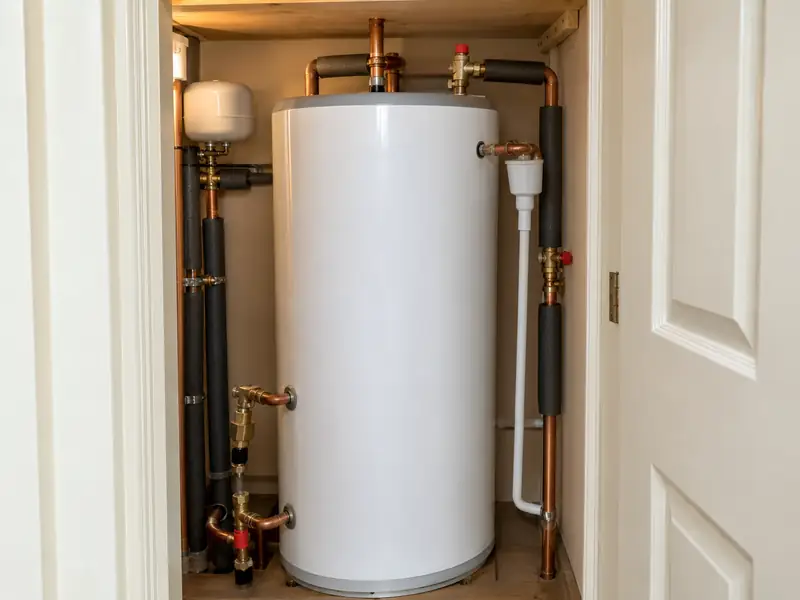
- Guide price
- From £1,200 inc VAT
- Survey
- Free home survey for installation enquiries
- Coverage
- England, Wales, Scotland and Northern Ireland
A heat pump hot water cylinder is an insulated tank that stores hot water heated by the heat pump, with a much larger internal coil than a cylinder designed for a boiler. Heat pumps heat water to a lower temperature than boilers, typically around 45–55°C, so a bigger coil is needed to pass heat into the stored water quickly. A standard boiler cylinder would heat slowly and make the heat pump work harder than it should.
Every air-to-water heat pump installation needs a cylinder, because there is no heat pump equivalent of a combi boiler that heats water instantly. If you have a combi now, the main design question is where the cylinder will go. If you already have a cylinder, it will almost always need replacing with a heat pump model, though the same cupboard can often be reused if it is large enough.
Most heat pump cylinders are unvented, meaning they run at mains water pressure and give strong flow from every tap without a cold water tank in the loft. Unvented cylinders have safety controls that must be fitted and checked by someone qualified to work on them. We size the cylinder from your household and bathrooms, confirm your mains water supply can support it, and plan the space, pipework and discharge route at the survey.
Who it suits
- Every air-to-water heat pump installation, whatever the existing boiler
- Homes replacing a combi boiler that need space found for a cylinder
- Households with older vented cylinders and loft tanks who want mains-pressure showers
- Larger families or homes with two or more bathrooms
- Homes with solar PV that want to store daytime electricity as hot water
Things to consider
- A cylinder needs floor space of roughly 600 mm by 600 mm and a height that suits the model, plus room for pipework and controls.
- Unvented cylinders need adequate mains water pressure and flow; a weak incoming supply can narrow the choice.
- A discharge pipe must be routed to a safe point outside, which affects where the cylinder can go.
- Hot water is stored, not instant, so a cylinder that is too small can run out at busy times.
- Replacing a combi often means giving up a cupboard or part of a room.
What size hot water cylinder do I need with a heat pump?
The cylinder size you need depends mainly on how many people live in the home and how many showers or baths are used at busy times.
- 1–2 people, one bathroom: typically around 150 litres
- 3–4 people, one or two bathrooms: typically around 180–210 litres
- 5 or more people, or two or more bathrooms in regular use: typically around 250–300 litres
These are starting points, not rules. High-flow showers, a large bath or several people showering back to back push the figure up, while a household that showers at different times may manage with less. We also consider whether solar PV will heat water during the day, which can justify a little more storage.
Where can a heat pump cylinder go?
A heat pump cylinder can go in any space with enough room, a floor strong enough for its full weight and a practical route for pipes to the heat pump and for the discharge pipe. Common places are an existing airing cupboard (often enlarged), a utility room, a landing cupboard, under-stairs space if it is tall enough, or an integral garage with well-insulated pipework.
A typical cylinder is 550–600 mm in diameter and anywhere from about 1.2 m to 2 m tall, depending on capacity. Slimline and compact models exist for awkward spaces, and some systems combine the cylinder with the indoor controls in one tall unit. Lofts are rarely suitable because of weight, access and the risk of freezing.
What are the rules for unvented cylinders?
Unvented cylinders store hot water at mains pressure, so the building regulations in each UK nation require them to be installed by someone qualified to work on unvented hot water systems, with the installation notified or registered as required where you live. The safety devices include a temperature and pressure relief valve, an expansion vessel and a tundish, a small open fitting that shows if water is discharging, with a discharge pipe routed to a safe point outside.
These devices should be checked once a year, which we include in an annual heat pump service. A dripping tundish or water at the discharge point is a sign to call an engineer rather than ignore it.
What is a legionella cycle?
A legionella cycle is a scheduled programme that heats the stored water to around 60°C or more for a short period, typically once a week, to control legionella bacteria. Because heat pumps normally store water at a lower temperature, the cycle is usually completed by the cylinder's immersion heater or by the heat pump's own boost function.
The cycle uses a small amount of extra electricity, so we set it to run at a sensible time, such as during a cheaper tariff period or while solar panels are generating. You should not need to do anything once it is set up, and the setting is checked at each service.
What's included
- Cylinder sizing based on your household, bathrooms and hot water habits
- Supply of a heat pump cylinder with a large-area coil and immersion backup
- Unvented safety kit: relief valves, expansion vessel, tundish and discharge pipework
- Removal of the old cylinder and, where relevant, cold water tanks in the loft
- Mains water pressure and flow check before the cylinder is chosen
- Hot water timing and legionella cycle set up at commissioning
- Notification or registration of the unvented installation as required
Heat pump hot water cylinders guide prices
| Work | Guide price |
|---|---|
| Heat pump hot water cylinder (supplied and fitted) | £1,200–£2,200 |
Supplied and fitted, inc VAT. Included in every full system price.
Heat pump hot water cylinders questions
Can I keep my existing hot water cylinder with a heat pump?
Usually not. Cylinders designed for boilers have a small coil that cannot transfer heat quickly at heat pump temperatures, so the water would reheat slowly and efficiency would suffer. A heat pump cylinder has a much larger coil. The new cylinder can often go in the same cupboard, though, if there is enough height and floor space.
How much does a heat pump cylinder cost?
A heat pump hot water cylinder has a guide price of £1,200–£2,200, installed and including VAT. In a full heat pump installation the cylinder is already included in the system guide price, so this figure mainly applies where a cylinder is replaced on its own. Capacity, coil design and the pipework needed affect where your price sits.
I have a combi boiler. Where will the cylinder go?
Moving from a combi to a heat pump means finding space for a cylinder, usually somewhere around 600 mm square and up to about 2 m tall. Common choices are a bedroom or landing cupboard, a utility room, under the stairs or an integral garage. The surveyor looks at your layout and suggests options, including slimline models where space is tight.
Will I run out of hot water with a heat pump?
Not if the cylinder is sized to how your household uses hot water. Unlike a combi, hot water is stored, so very heavy use, such as several long showers back to back, can use up the stored volume before it reheats. Sizing for your busiest period, and timing reheats sensibly, avoids this for most homes.
Do I need good water pressure for an unvented cylinder?
Yes. An unvented cylinder runs at mains pressure, so it needs enough incoming pressure and flow to supply your taps and showers well. We measure your mains supply at the survey. If flow is low, options include a different cylinder type or an upgrade to the incoming supply pipe, which we explain before you commit.
Does a heat pump cylinder need servicing?
Yes. An unvented cylinder's safety devices should be checked every year, including the relief valves, the expansion vessel charge and the discharge pipework. This is normally done as part of the annual heat pump service, and it is often a condition of the cylinder manufacturer's warranty. Keep the cylinder paperwork with your heat pump handover documents.