
- Guide price
- From £9,500 inc VAT
- Survey
- Free home survey for installation enquiries
- Coverage
- England, Wales, Scotland and Northern Ireland
Replacing electric heating with a heat pump means taking out storage heaters, panel heaters or an electric boiler and installing an air-to-water heat pump that heats water for radiators or underfloor heating and a hot water cylinder. If you already have an electric boiler and radiators, the change is similar to a boiler swap. If you have storage or panel heaters, there is no wet system yet, so radiators and pipework need to be installed throughout.
The efficiency difference is the main reason to consider it. A panel heater turns one unit of electricity into one unit of heat, so heat costs the full unit rate of 26.32p per kWh at the October to December 2026 price cap. A heat pump with a seasonal efficiency of 3.0 delivers heat for about 8.8p per kWh. Storage heaters on an off-peak tariff narrow the gap, so we compare against your actual tariff, insulation and expected flow temperature.
In England and Wales, replacing electric heating is eligible for the Boiler Upgrade Scheme, so eligible owners can receive £7,500 towards an air-to-water system. Flats need extra thought about where the outdoor unit goes and who must agree to it, and for some an air-to-air system is a simpler fit.
Who it suits
- Homes with storage heaters or panel heaters throughout
- Properties with an electric boiler and existing radiators
- Bungalows and houses with suspended timber floors that make pipe runs easier
- Owners planning redecoration or other building work at the same time
- Flats with a suitable wall, balcony or ground-floor space for the unit
Things to consider
- Fitting radiators and pipework from scratch adds cost, disruption and time on site.
- Solid concrete floors make hidden pipe runs harder, so some pipes may run in walls or along skirting.
- Leaseholders usually need the freeholder's consent, and a flat may need planning permission; the rules differ in each nation and we check at survey.
- Storage heaters on a cheap off-peak tariff narrow the running cost gap, so compare on your actual tariff.
- Space for a hot water cylinder is still needed.
What work is needed to add radiators and pipework?
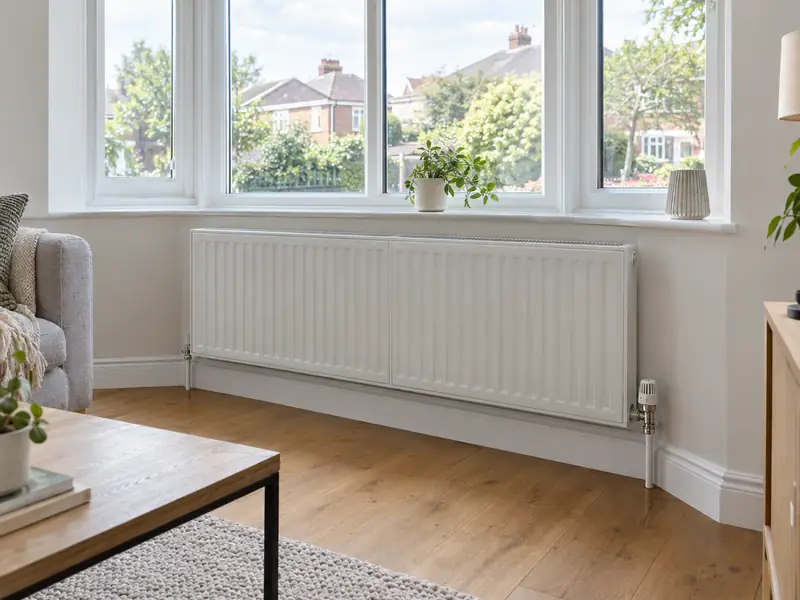
Fitting a wet system means running flow and return pipes from the heat pump and cylinder to every room, then hanging radiators sized for low flow temperatures. With suspended timber floors, pipes usually run under lifted floorboards; on solid floors they may run in walls, along skirting or down from the ceiling void above.
The survey plans pipe routes room by room so the disruption is predictable. Expect floorboards up, some holes through walls and minor making good afterwards; redecoration is usually yours to arrange. A whole home with new radiators and pipework typically takes longer on site than the 2–4 days of a straightforward boiler swap, and the programme in your quote shows the order of rooms.
As guide prices, installed and including VAT, a heat-pump radiator is £250–£450 each and a set of about ten is £2,000–£5,000. For homes with no wet system, the radiator and pipework work is priced on top of the system after the survey.
Is the grant available when replacing storage heaters?
Yes, in England and Wales the Boiler Upgrade Scheme covers owners of existing homes replacing fossil-fuel or electric heating, which includes storage heaters, panel heaters and electric boilers. The grant is £7,500 for an air-to-water heat pump, and the system must meet the home's full heating and hot water needs.
The MCS-certified installer applies to Ofgem and deducts the grant from your quote. In Scotland, Home Energy Scotland funding is assessed separately and needs a written offer before work starts; Northern Ireland has no dedicated homeowner heat pump grant at present.
Can I fit a heat pump in a flat?
Often, yes, but flats need more checks than houses. The outdoor unit needs a position with airflow — a balcony, a ground-floor yard, a flat roof or a wall bracket — and the noise assessment has to work for neighbours above, below and alongside.
Leaseholders normally need consent from the freeholder or management company before fixing anything to the building, and planning permission may be needed; each nation has its own rules, which we check at survey. A small flat has low heat loss, so the system can be compact. Where a wet system and cylinder are hard to fit, an air-to-air heat pump may be simpler, with hot water from an existing electric cylinder.
What happens to my existing electric hot water cylinder?
Most homes with electric heating have a cylinder heated by an immersion element, often on an off-peak tariff. It usually cannot be connected to a heat pump because it has no internal coil, or one too small for low-temperature heating, so a heat pump cylinder replaces it, often in the same cupboard. The new cylinder keeps an immersion element as a backup.
What's included
- Free survey with room-by-room heat loss and pipe route planning
- Removal of storage heaters, panel heaters or the electric boiler
- New radiators sized for low flow temperatures, with pipework to each room
- Outdoor unit, heat pump cylinder and controls
- Electrical connection and network operator notification where required
- Commissioning and MCS certificate, with the grant claimed for you in England and Wales where eligible
Electric heating to heat pump guide prices
| Home | Typical size | Installed guide price | After £7,500 grant |
|---|---|---|---|
| 1–2 bedroom flat or small terrace | 4–5 kW | £9,500–£12,500 | £2,000–£5,000 |
| 2–3 bedroom terrace or semi | 5–7 kW | £10,500–£13,500 | £3,000–£6,000 |
| 3 bedroom semi or small detached | 6–9 kW | £12,000–£15,500 | £4,500–£8,000 |
| 4 bedroom detached | 8–12 kW | £14,000–£18,000 | £6,500–£10,500 |
| 5+ bedroom or larger older house | 11–16 kW | £16,500–£22,500 | £9,000–£15,000 |
Installed, inc VAT: unit, cylinder, controls, minor pipework and commissioning.
Replacing electric heating with a heat pump questions
Can I replace storage heaters with a heat pump?
Yes. Storage heaters are removed and replaced with an air-to-water heat pump connected to new radiators or underfloor heating and a hot water cylinder. Because there is no existing wet system, pipework has to be run to each room, so the job is larger than a boiler swap. The survey plans pipe routes and radiator sizes before you receive a written quote.
Is a heat pump cheaper to run than storage heaters?
It can be, but it depends on your tariff. Direct electric heat costs the full unit rate, 26.32p per kWh at the October to December 2026 price cap, while a heat pump with a seasonal efficiency of 3.0 delivers heat for about 8.8p per kWh. Storage heaters charged on a cheap overnight rate narrow that gap, so the survey compares on your actual tariff, insulation and expected flow temperature.
How disruptive is fitting radiators in a home that has none?
More disruptive than a boiler swap, but planned. Floorboards are lifted to run pipes, some holes are drilled through walls and radiators are hung room by room. Rooms are worked on in a set order so you can keep living at home, and holes are made good, while redecoration is usually yours. The programme in your quote shows how long each stage typically takes.
Do I qualify for the Boiler Upgrade Scheme if I have electric heating?
In England and Wales, owners of existing homes replacing electric heating can qualify, provided the heat pump meets the home's full heating and hot water needs and the other scheme conditions are met. The grant is £7,500 for an air-to-water system. The scheme does not cover Scotland or Northern Ireland; Scotland has separate Home Energy Scotland funding.
What if I live in a flat?
Many flats can have a heat pump, but you need a suitable outdoor position, such as a balcony, yard or wall bracket, and leaseholders need consent from the freeholder or management company. Planning permission may be needed depending on the nation and the building, which we check at survey. Where a wet system is impractical, an air-to-air heat pump with separate hot water is an alternative.
Can I keep my electric immersion cylinder?
Usually not for heating by the heat pump, because a standard immersion cylinder has no coil, or one too small to take heat at low flow temperatures. A heat pump cylinder replaces it, often in the same cupboard, and keeps an immersion element as backup. If you choose an air-to-air system instead, which does not make hot water, the existing cylinder stays in use.