
- Guide price
- From £11,000 inc VAT
- Survey
- Free home survey for installation enquiries
- Coverage
- England, Wales, Scotland and Northern Ireland
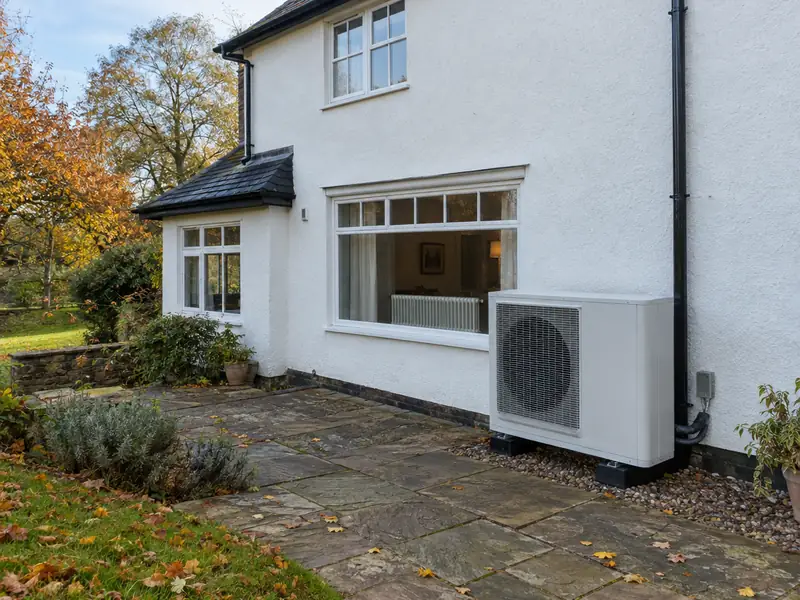
A high-temperature heat pump is an air-to-water heat pump able to produce flow temperatures of around 65–75°C, close to what a gas or oil boiler delivers, instead of the 35–50°C at which standard heat pumps run most efficiently. That means existing radiators can often heat rooms much as they do now, without being replaced with larger ones.
This suits homes where changing radiators is hard: period and listed properties with cast-iron radiators or fragile finishes, homes with microbore pipework that is difficult to replace, and rooms with no space for a larger radiator. Many of these units use R290 (propane), a natural refrigerant that makes higher water temperatures more achievable than some earlier refrigerants did.
The trade-off is efficiency. The hotter the water a heat pump makes, the more electricity it needs for each unit of heat, so a system running at 65°C has a lower seasonal efficiency than one running at 45°C. Good design still matters: weather compensation runs the unit cooler on mild days and only raises the temperature in the coldest weather, which keeps running costs down across the year.
Who it suits
- Period and listed homes where the radiators are part of the character
- Homes with microbore pipework that would be disruptive to replace
- Rooms with no wall space for a larger radiator
- Owners who want fewer changes inside the house
- Older homes where insulation improvements are limited
Things to consider
- Running at higher temperatures lowers seasonal efficiency and raises running costs compared with a low-temperature design.
- High-temperature units cost more: a guide extra of £1,500–£3,000 over a standard unit, installed and including VAT.
- A heat loss survey is still needed, and the coldest rooms may still need a larger radiator.
- Propane-based units must be sited with the manufacturer's clearance zone in mind.
How hot can a high-temperature heat pump run?
High-temperature units can typically reach flow temperatures of around 65–75°C, depending on the model and the outdoor temperature. For most of the year they do not need to: weather compensation sets the flow temperature from the outside temperature, so on a mild autumn day the system might run at 40–45°C and only climb towards its maximum in a cold snap.
The design sets the maximum flow temperature your radiators need on the coldest design day, using the room-by-room heat loss calculation. The lower that figure can be kept, the higher the efficiency.
How much does the higher temperature affect running costs?
Higher flow temperatures mean a lower seasonal efficiency (SCOP), and so more electricity per unit of heat. At the October to December 2026 price cap, a heat pump with a SCOP of 3.5 delivers heat for about 7.5p per kWh and at 3.0 about 8.8p. A system that spends much of the winter at high temperatures may have a SCOP nearer 3.0 or below, costing more per kWh of heat.
For comparison, a 90% efficient gas boiler delivers heat for about 8.9p per kWh. Insulation, the flow temperature your radiators need, your tariff and how you use the controls all change the result, so the survey estimate is based on your home.
Should I change some radiators anyway?
Often a combination works well: keep most radiators and upsize the one or two in the coldest rooms. That can bring the maximum flow temperature down from, say, 70°C to 55°C, which improves efficiency every day the heating runs.
Insulation helps too. Loft insulation, draught-proofing, secondary glazing or heavy curtains on large windows all reduce heat loss, so the system can run cooler. The design can show how each change affects the flow temperature needed.
What does a high-temperature heat pump cost?
As a guide price, a high-temperature unit adds £1,500–£3,000 over a standard unit, installed and including VAT. A full system with a standard unit for a three-bedroom semi has a guide price of £12,000–£15,500, so a high-temperature system typically sits above that range. In England and Wales, high-temperature air-to-water units are covered by the Boiler Upgrade Scheme like any other air source heat pump, for eligible homes. Your final price is fixed in a written quote after the survey.
What's included
- Free survey with room-by-room heat loss and radiator output checks
- Design of the maximum flow temperature and weather compensation curve
- High-temperature outdoor unit, cylinder and controls
- Selective radiator upgrades where they improve efficiency
- Siting to meet the manufacturer's clearance zone and the MCS noise assessment
- Commissioning, MCS registration and, in England and Wales, the grant claim where eligible
High-temperature heat pumps guide prices
| Home | Typical size | Installed guide price | After £7,500 grant |
|---|---|---|---|
| 1–2 bedroom flat or small terrace | 4–5 kW | £9,500–£12,500 | £2,000–£5,000 |
| 2–3 bedroom terrace or semi | 5–7 kW | £10,500–£13,500 | £3,000–£6,000 |
| 3 bedroom semi or small detached | 6–9 kW | £12,000–£15,500 | £4,500–£8,000 |
| 4 bedroom detached | 8–12 kW | £14,000–£18,000 | £6,500–£10,500 |
| 5+ bedroom or larger older house | 11–16 kW | £16,500–£22,500 | £9,000–£15,000 |
Installed, inc VAT: unit, cylinder, controls, minor pipework and commissioning. A high-temperature unit typically adds £1,500–£3,000.
High-temperature heat pumps questions
Can a heat pump work with my existing radiators?
Often, yes, especially with a high-temperature unit. Standard heat pumps run most efficiently at 35–50°C, so some radiators may be too small at those temperatures. A high-temperature unit can run at around 65–75°C, so existing radiators can usually heat rooms much as they do with a boiler, at a cost in efficiency. The survey checks every radiator against its room's heat loss.
Are high-temperature heat pumps less efficient?
Yes, when they run hot. Every heat pump uses more electricity per unit of heat as the flow temperature rises, so a unit running at 70°C is less efficient than one running at 45°C. With weather compensation it runs cooler for much of the year, which narrows the gap. The design aims to keep the maximum temperature as low as your radiators allow.
Are high-temperature heat pumps eligible for the grant?
In England and Wales, yes. A high-temperature unit is an air-to-water heat pump, so eligible owners of existing homes can receive £7,500 through the Boiler Upgrade Scheme, or £9,000 when replacing oil or LPG within the published dates. Scotland's Home Energy Scotland funding has its own conditions, and Northern Ireland has no dedicated homeowner grant at present.
Is a high-temperature heat pump right for a listed building?
It can be, because it reduces the need to replace period radiators or lift historic floors for new pipework. The outdoor unit position still matters: in England, listed buildings need listed building consent for external works, and the other nations have their own rules. We check what applies at survey and look for discreet positions, such as a rear courtyard or behind an outbuilding.
Why do many high-temperature units use R290?
R290 is propane, a natural refrigerant with a very low global warming impact. Its properties make higher water temperatures more achievable than with some earlier refrigerants. Because it is flammable, manufacturers set clearance zones around the outdoor unit from windows, doors, drains and other openings, which the survey uses when choosing a position.
Do I still need a hot water cylinder?
Yes. Like other air-to-water heat pumps, a high-temperature unit heats a stored cylinder rather than supplying hot water on demand. Its higher output temperature can help the cylinder reach the temperature needed for its periodic legionella cycle with less reliance on the immersion heater. The cylinder is sized for your household at survey.