
- Area
- Clwyd
- Postcode district
- CH7
- Nation
- Wales
- Guide price
- From £250 inc VAT
- Survey
- Free for installation enquiries
Heat pump radiators for Mold homes
A heat pump suits most Mold homes, but the details decide how efficiently it runs. Our survey looks at insulation, radiators and hot water use room by room.
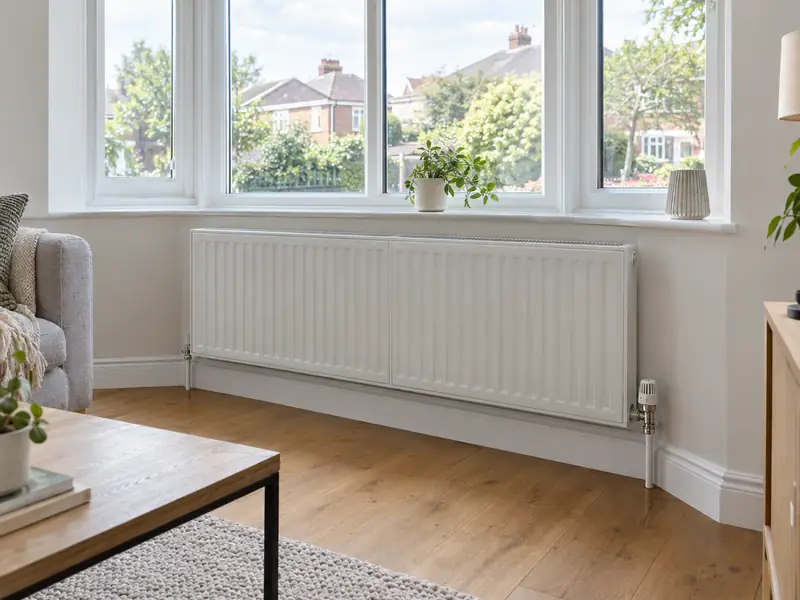
In Mold, bay-windowed front rooms are often the rooms that need a larger radiator when moving to a heat pump. Many older houses in Mold still have their original single-panel radiators, so the survey checks each one against the room it heats.
We size each radiator to your room-by-room heat loss so a heat pump can heat your home at a low, efficient flow temperature.
- Homeowners who want the lowest practical flow temperature for efficiency
- Rooms that already feel slow to heat, such as bay-windowed living rooms
- Rooms with little wall space, where a fan-assisted radiator fits better
What's included
- Supply and fitting of new radiators, valves and brackets
- Balancing every radiator so each room heats evenly
- A radiator schedule showing which radiators stay, which change and their outputs
- Room-by-room heat loss figures for every heated room
- Draining, refilling, cleaning and inhibitor treatment of the heating system
We plan radiator upgrades in Mold so floorboards are lifted only where pipework genuinely needs changing.
Grants and rules for heat pumps in Wales
In Wales the Boiler Upgrade Scheme gives £7,500 towards an air source heat pump (£9,000 if it replaces oil or LPG, from 21 July 2026 to 31 March 2027; £2,500 for air-to-air). The MCS-certified installer named in your quote applies to Ofgem for you, and the grant comes off your Mold quote.
Installing heat pumps is zero-rated for VAT across the UK until 31 March 2027. Wales has its own permitted development rules for air source heat pumps, so we check what applies to your property, including listed building and conservation-area constraints, at the survey.
Heat pump radiators prices in Mold
Here are typical prices for heat pump radiator upgrades in Clwyd, installed and including VAT. Use the guide price tool for a figure based on your home, then a survey confirms it in writing.
| Work | Guide price |
|---|---|
| Replacement radiator, sized for a heat pump (each, fitted) | £250–£450 |
| Upgrade of about 10 radiators | £2,000–£5,000 |
| Pipework upgrade (e.g. microbore to larger bore) | £1,500–£3,500 |
Installed, inc VAT. The survey lists which radiators need changing.
Designing for Mold's winters
Mold has about 7 hours 32 minutes of daylight at midwinter and 16 hours 58 minutes at midsummer. That swing matters if you pair a heat pump with solar panels: summer generation can cover much of the hot water, winter generation far less.
From survey to switch-on in Mold
- Send your postcode and a few details, or use the guide price tool.
- A surveyor visits your Mold home, measures every room and checks where the outdoor unit can go.
- You receive a heat loss design and a fixed written quote, with any grant shown where it applies.
- Installers fit the unit, cylinder and any radiator changes, typically over 2–4 days on site.
- The system is commissioned, set up with weather compensation and handed over with the paperwork.
Heat pump radiator upgrades in Mold: questions
Where would the outdoor unit go on a Mold house?
Usually at the side or rear, on a level base with space around it for airflow and servicing, away from bedroom windows where possible. The surveyor checks positions at your Mold home.
Can you service a heat pump in Mold that someone else installed?
Yes. We arrange servicing and repairs for most air source heat pumps in Mold, whoever fitted them. Tell us the make and model when you book.
How long does a heat pump survey take in Mold?
A home survey in Mold usually takes one to two hours. The surveyor measures every heated room, checks windows, walls and radiators, and looks at where the outdoor unit and cylinder can go.
Can radiators be changed without draining the whole system?
Radiator changes normally mean draining the heating system, which is why they are usually done as part of the heat pump installation. The system is then refilled, flushed, treated with inhibitor and balanced. Doing the radiators at the same time avoids draining twice and means the new radiators are commissioned with the heat pump.
Do I need new radiators for a heat pump?
Not necessarily: many homes keep most of their radiators and replace only a few. The heat loss survey checks each room against its existing radiator at the planned flow temperature. Rooms with large windows, high ceilings or extensions are the usual candidates for an upgrade, while bedrooms often need no change. Your radiator schedule lists every decision.