
- Area
- Lancashire
- Postcode district
- BB10
- Nation
- England
- Guide price
- From £240 inc VAT
- Survey
- Free for installation enquiries
Before you book: heat pump radiator upgrades in Burnley
Most homes can run on a heat pump if the system is designed properly, and Burnley is no different. The key is matching the heat pump and radiators to the home's heat loss.
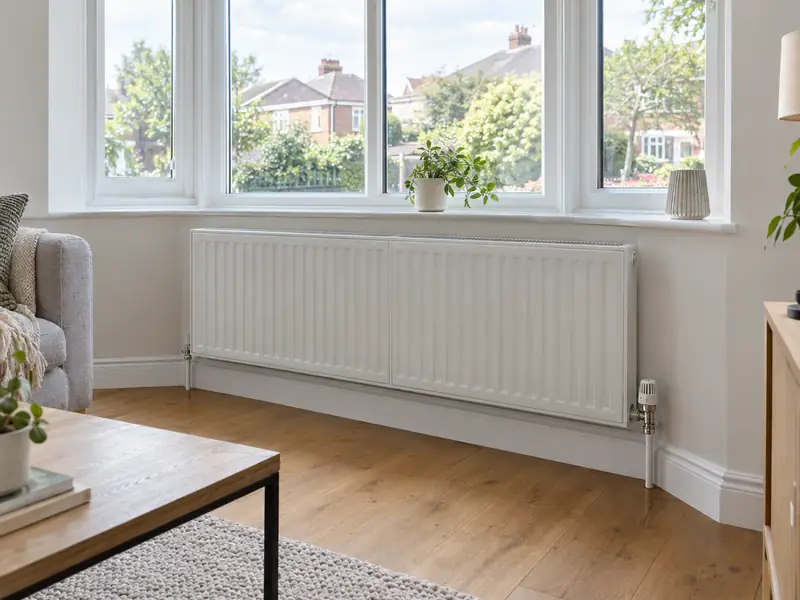
We plan radiator upgrades in Burnley so floorboards are lifted only where pipework genuinely needs changing. In Burnley, bay-windowed front rooms are often the rooms that need a larger radiator when moving to a heat pump.
We size each radiator to your room-by-room heat loss so a heat pump can heat your home at a low, efficient flow temperature.
- Extensions and loft conversions with large areas of glazing
- Homeowners who want the lowest practical flow temperature for efficiency
- Rooms with little wall space, where a fan-assisted radiator fits better
What's included
- Supply and fitting of new radiators, valves and brackets
- Pipework checks and any agreed pipe upgrades
- Room-by-room heat loss figures for every heated room
- Balancing every radiator so each room heats evenly
- A radiator schedule showing which radiators stay, which change and their outputs
Extensions and kitchen-diners around Burnley with large glazed areas get their own radiator calculation.
Grants and rules for heat pumps in England
In England the Boiler Upgrade Scheme gives £7,500 towards an air source heat pump (£9,000 if it replaces oil or LPG, from 21 July 2026 to 31 March 2027), and since 28 April 2026 a valid EPC is no longer needed. The grant is applied for by the MCS-certified installer and shown as a deduction on your Burnley quote.
There is no VAT on installing a heat pump anywhere in the UK until 31 March 2027. In England most houses can have an air source heat pump under permitted development, provided the unit meets the MCS noise and siting standards; the old 1 m boundary limit was removed on 29 May 2025. We flag listed buildings, flats and sensitive conservation-area positions at survey.
What to budget for heat pump radiator upgrades in Burnley
These are guide prices for Lancashire, installed and including VAT. Your final price is fixed in a written quote after the survey and depends on the heat loss of the house, the radiators that need changing and where the unit goes.
| Work | Guide price |
|---|---|
| Replacement radiator, sized for a heat pump (each, fitted) | £240–£440 |
| Upgrade of about 10 radiators | £1,950–£4,900 |
| Pipework upgrade (e.g. microbore to larger bore) | £1,450–£3,450 |
Installed, inc VAT. The survey lists which radiators need changing.
Designing for Burnley's winters
Burnley sees roughly 7 hours 24 minutes of daylight in December and 17 hours 06 minutes in June. With a longer heating season than the south, the gains from low flow temperatures and good controls add up over the year.
What happens after you enquire in Burnley?
- Start online with a guide price or call us.
- A home survey in Burnley gives us the room-by-room heat loss.
- Your written quote sets out the design, the price and the grant position where you live.
- Installation is booked for dates that suit you; most homes take 2–4 days on site.
- After commissioning you get a handover of the controls and settings, plus the certificates.
Heat pump radiator upgrades in Burnley: questions
Do I need new radiators for a heat pump in Burnley?
Often some, not all. Heat pumps run best at lower water temperatures, so rooms with small radiators may need larger ones. The survey of your Burnley home gives a room-by-room list.
How long does installation take in Burnley?
Most installations take 2–4 days on site. Jobs with several radiator changes or new pipework take longer, and your quote for a Burnley home states the expected time.
Do you cover Colne as well as Burnley?
Yes. We arrange surveys and installation in Colne, which is about 5 miles north-east of Burnley, and across Lancashire.
Do I need new radiators for a heat pump?
Not necessarily: many homes keep most of their radiators and replace only a few. The heat loss survey checks each room against its existing radiator at the planned flow temperature. Rooms with large windows, high ceilings or extensions are the usual candidates for an upgrade, while bedrooms often need no change. Your radiator schedule lists every decision.
Will new radiators be much bigger than my old ones?
Sometimes, but not always. Swapping a single-panel radiator for a double or triple-panel model of the same height and width can raise output substantially, adding only depth from the wall. Where that is not enough, a longer or taller radiator, or a second radiator in the room, may be needed. We agree sizes and positions with you before anything is ordered.