
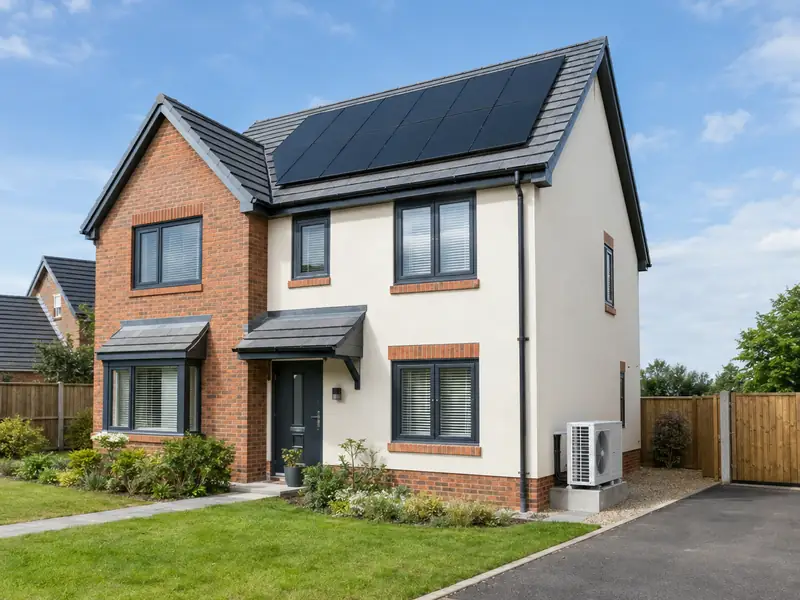
It is worth being clear about the seasons. Solar panels generate most from spring to early autumn, when a heat pump is mainly heating hot water. In December and January, when heating demand peaks, a typical roof produces only a small fraction of its summer output and covers little of the heat pump's needs. The strongest fit is daytime hot water heating for much of the year, with a battery or a time-of-use tariff helping in winter.
For Suffolk households out during the day, a battery can carry daytime solar into the evening heating period. Roof orientation and shading vary street by street in Suffolk, so solar is assessed on each roof individually. Homes in Suffolk with existing panels can often have the heat pump set to heat water from their daytime output.
Who it suits
- Households considering a battery to store daytime or cheaper overnight electricity
- Homes with existing solar PV that currently export much of their output
- Households at home during the day or with flexible hot water timing
- Homes with a roof facing anywhere from east through south to west, with little shading
Grants and rules for heat pumps in England
In England the Boiler Upgrade Scheme gives £7,500 towards an air source heat pump (£9,000 if it replaces oil or LPG, from 21 July 2026 to 31 March 2027), and since 28 April 2026 a valid EPC is no longer needed. The grant is applied for by the MCS-certified installer and shown as a deduction on your quote.
There is no VAT on installing a heat pump anywhere in the UK until 31 March 2027. In England most houses can have an air source heat pump under permitted development, provided the unit meets the MCS noise and siting standards; the old 1 m boundary limit was removed on 29 May 2025. We flag listed buildings, flats and sensitive conservation-area positions at survey.
Prices
Solar panels and batteries are quoted separately after a roof survey. For heat pump system prices see the guide prices.
Towns we cover in Suffolk
We cover 11 towns in Suffolk for heat pumps with solar panels and batteries. Each links to local guide prices and the grant position for England.
| Town | Postcode district | Nearest town | Midwinter daylight |
|---|---|---|---|
| Ipswich | IP1 | Woodbridge | 7 h 44 min |
| Lowestoft | NR32 | Beccles | 7 h 39 min |
| Bury St Edmunds | IP33 | Stowmarket | 7 h 42 min |
| Haverhill | CB9 | Newmarket | 7 h 44 min |
| Felixstowe | IP11 | Harwich | 7 h 45 min |
| Sudbury | CO10 | Halstead | 7 h 44 min |
| Stowmarket | IP14 | Ipswich | 7 h 42 min |
| Newmarket | CB8 | Haverhill | 7 h 42 min |
| Beccles | NR34 | Lowestoft | 7 h 40 min |
| Southwold | IP18 | Beccles | 7 h 41 min |
| Woodbridge | IP12 | Ipswich | 7 h 43 min |
Heat pumps with solar panels and batteries questions
Do I need a battery to benefit from solar with a heat pump?
No. Without a battery you can still use solar generation directly by timing hot water heating for the middle of the day. A battery adds flexibility by storing surplus for the evening, or by charging from a cheaper overnight tariff in winter. Whether it suits you depends on how much you would otherwise export and on your tariff.
Should I fit solar panels before or after a heat pump?
Either order works, but planning both together helps. Knowing the heat pump's electricity use helps size the panels and any battery, and the electrical work for both can be coordinated, including the consumer unit and any notification to the network operator. If you already have panels, the heat pump controls can be set to use their output for hot water.
Is a solar diverter useful with a heat pump?
It can be, but less so than with a gas boiler. A diverter heats water through the immersion heater, which turns one unit of electricity into one unit of heat, while a heat pump typically makes around three. Scheduling the heat pump to heat water at midday usually uses solar more efficiently, with a diverter adding top-ups on very sunny days.
Can solar panels run my heat pump in winter?
Only partly. In midwinter, solar panels typically generate a small fraction of their summer output, and the shortest days coincide with the highest heating demand. Panels may help on bright winter afternoons, but most winter heating will run on grid electricity or a battery charged from a cheaper overnight tariff. Solar contributes most to hot water from spring to autumn.