
- Area
- Somerset
- Postcode district
- BA16
- Nation
- England
- Guide price
- From £9,500 inc VAT
- Survey
- Free for installation enquiries
Before you book: replacing an oil or LPG boiler with a heat pump in Street
A heat pump suits most Street homes, but the details decide how efficiently it runs. Our survey looks at insulation, radiators and hot water use room by room.
Cottages and farmhouses in and around Street often have solid walls, so the survey looks closely at construction and draughts. Owners across Somerset can have oil tank removal arranged alongside a heat pump installation in Street.
Off-gas homes have a lot to plan when switching to a heat pump: the fuel tank, older walls, rural power supplies and higher heat loss.
- Owners tired of fuel deliveries and tank maintenance
- Detached houses and bungalows with garden space for the unit
- Eligible homes in England and Wales within the higher grant window
What's included
- Help arranging LPG tank collection with your supplier
- Free survey with a detailed heat loss calculation for older construction
- Outdoor unit, heat pump cylinder, controls and radiator changes
- Network operator notification and electrical connection
- MCS certificate and grant application in England and Wales where eligible
For homes outside Street reached by a long drive or narrow lane, delivery of the unit and cylinder is planned in advance.
Grants and rules for heat pumps in England
In England the Boiler Upgrade Scheme gives £7,500 towards an air source heat pump (£9,000 if it replaces oil or LPG, from 21 July 2026 to 31 March 2027), and since 28 April 2026 a valid EPC is no longer needed. The grant is applied for by the MCS-certified installer and shown as a deduction on your Street quote.
Installing heat pumps is zero-rated for VAT across the UK until 31 March 2027. Since 29 May 2025, permitted development in England allows up to two air source heat pumps on a house, each up to 1.5 m³, with no blanket 1 m boundary rule — the installation must still meet the MCS planning standards, including the noise check. Listed buildings, flats and some conservation-area positions need extra consent, which we check at survey.
Guide prices for replacing an oil or LPG boiler with a heat pump in Street
These are guide prices for Somerset, installed and including VAT. Your final price is fixed in a written quote after the survey and depends on the heat loss of the house, the radiators that need changing and where the unit goes.
| Home | Typical size | Installed guide price | After £9,000 grant |
|---|---|---|---|
| 1–2 bedroom flat or small terrace | 4–5 kW | £9,500–£12,500 | £500–£3,500 |
| 2–3 bedroom terrace or semi | 5–7 kW | £10,500–£13,500 | £1,500–£4,500 |
| 3 bedroom semi or small detached | 6–9 kW | £12,000–£15,500 | £3,000–£6,500 |
| 4 bedroom detached | 8–12 kW | £14,000–£18,000 | £5,000–£9,000 |
| 5+ bedroom or larger older house | 11–16 kW | £16,500–£22,500 | £7,500–£13,500 |
Installed, inc VAT: unit, cylinder, controls, minor pipework and commissioning. The £9,000 Boiler Upgrade Scheme figure applies to oil and LPG replacements in England and Wales installed from 21 July 2026 to 31 March 2027.
Designing for Street's winters
Street sees roughly 7 hours 53 minutes of daylight in late December against 16 hours 34 minutes in June. Milder southern winters suit heat pumps well, though the system is still sized for a cold snap rather than an average day.
From survey to switch-on in Street
- Start online with a guide price or call us.
- A home survey in Street gives us the room-by-room heat loss.
- Your written quote sets out the design, the price and the grant position where you live.
- Installation is booked for dates that suit you; most homes take 2–4 days on site.
- After commissioning you get a handover of the controls and settings, plus the certificates.
Replacing an oil or LPG boiler with a heat pump in Street: questions
How long does a heat pump survey take in Street?
A home survey in Street usually takes one to two hours. The surveyor measures every heated room, checks windows, walls and radiators, and looks at where the outdoor unit and cylinder can go.
Where would the outdoor unit go on a Street house?
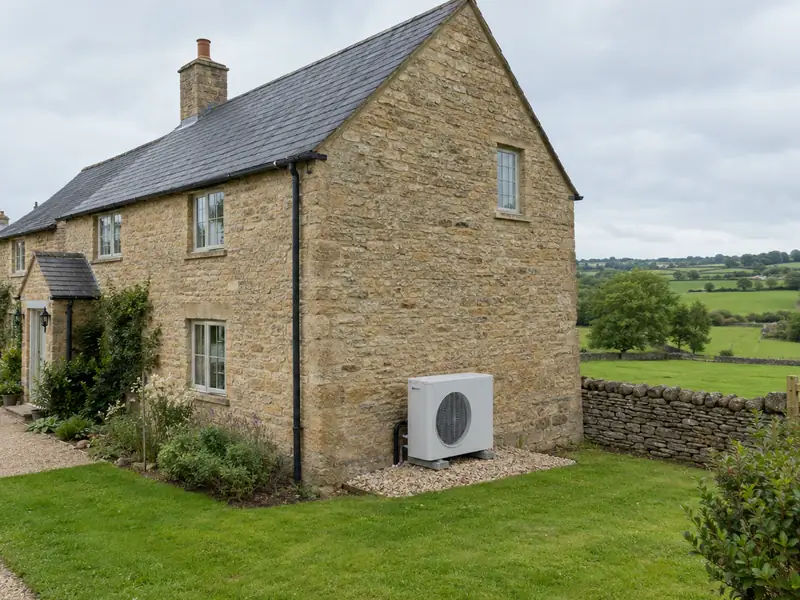
Usually at the side or rear, on a level base with space around it for airflow and servicing, away from bedroom windows where possible. The surveyor checks positions at your Street home.
How long does installation take in Street?
Most installations take 2–4 days on site. Jobs with several radiator changes or new pipework take longer, and your quote for a Street home states the expected time.
Do I have to remove my oil tank?
Not always, but it should be emptied and made safe. A tank in good condition can be drained, cleaned and left in place, though most owners prefer to have it taken away to free up space. Old or damaged tanks are usually removed. Your quote says which option is included, and any remaining oil and sludge is disposed of properly.
Will I need bigger radiators in an older cottage or farmhouse?
Often in some rooms, because thick solid walls and older windows lose more heat, and heat pumps work at lower water temperatures than oil boilers. The survey checks each room. Rooms with high ceilings or large windows are common candidates for a larger radiator. Where swapping radiators is impractical, a high-temperature unit can be considered, with lower efficiency as the trade-off.