
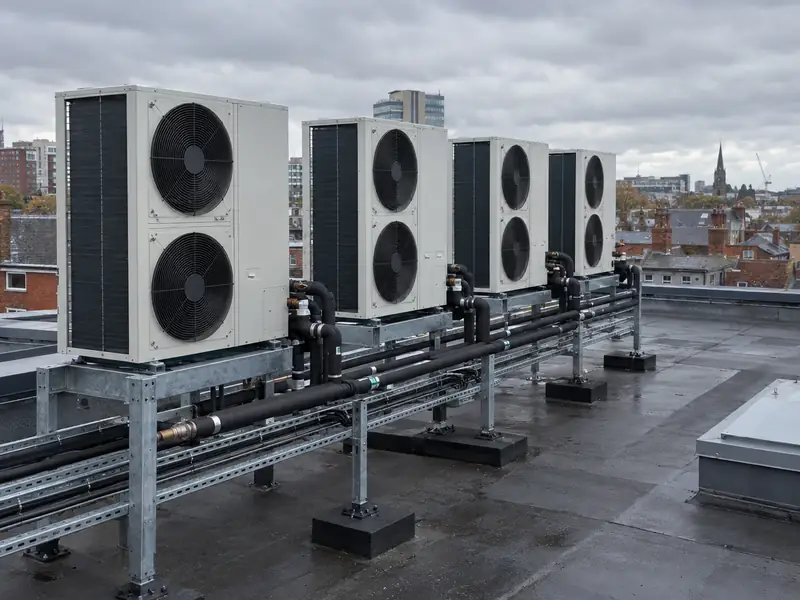
Design starts with the load: a heat loss calculation for the building, its occupancy and opening hours, how much hot water it uses and whether any spaces need cooling. From that we propose plant sizes and positions, on a roof, in a yard or in a plant enclosure, with the structural, electrical and noise checks each position needs. Larger plant may need a three-phase supply, which the network operator may need to provide or confirm.
For blocks of flats in Nottinghamshire, we assess whether individual units or a communal system suits the building and how it is managed. Premises in Nottinghamshire close to homes need careful plant siting and, where required, an acoustic assessment. On busy Nottinghamshire high streets, deliveries and crane lifts are scheduled around access restrictions and opening hours.
Who it suits
- Offices, shops and small commercial premises replacing gas or oil boilers
- Landlords and managing agents planning low-carbon upgrades
- Blocks of flats and houses in multiple occupation needing shared or per-flat systems
- Premises that also want cooling in some areas
Grants and rules for heat pumps in England
Homes in Nottinghamshire can use the Boiler Upgrade Scheme, which takes £7,500 off the cost of an air source heat pump when it replaces fossil-fuel or electric heating. Replacing oil or LPG heating qualifies for £9,000 for installations from 21 July 2026 to 31 March 2027, and air-to-air systems for £2,500. The MCS-certified installer named in your quote applies for the grant and deducts it from the price.
There is no VAT on installing a heat pump anywhere in the UK until 31 March 2027. In England most houses can have an air source heat pump under permitted development, provided the unit meets the MCS noise and siting standards; the old 1 m boundary limit was removed on 29 May 2025. We flag listed buildings, flats and sensitive conservation-area positions at survey.
Prices
Commercial systems are priced after a site survey and load calculation.
Towns we cover in Nottinghamshire
We cover 10 towns in Nottinghamshire for commercial heat pump installation. Each links to local guide prices and the grant position for England.
| Town | Postcode district | Nearest town | Midwinter daylight |
|---|---|---|---|
| Nottingham | NG1 | Arnold | 7 h 34 min |
| Mansfield | NG18 | Hucknall | 7 h 32 min |
| Worksop | S80 | Retford | 7 h 30 min |
| Newark-on-Trent | NG24 | Southwell | 7 h 33 min |
| Arnold | NG5 | Nottingham | 7 h 34 min |
| Hucknall | NG15 | Arnold | 7 h 33 min |
| Retford | DN22 | Worksop | 7 h 30 min |
| Eastwood | NG16 | Ilkeston | 7 h 34 min |
| Bingham | NG13 | Nottingham | 7 h 34 min |
| Southwell | NG25 | Newark-on-Trent | 7 h 33 min |
Commercial heat pump installation questions
Can heat pumps go on a flat roof?
Yes, flat roofs are a common position for commercial plant. The roof needs a structural check for the weight of the units and their frames, and the installation usually needs a lifting plan, anti-vibration mounts, drainage for defrost water and safe access for maintenance. Pipe and cable routes from the roof into the building are planned at survey.
Can commercial heat pumps provide cooling as well?
Some can. Air-to-water heat pumps are mainly used for heating and hot water, but certain units can also supply chilled water for fan coil units. Air-to-air systems heat and cool directly through indoor units and suit offices and shops where cooling is wanted. The survey identifies which areas need cooling and recommends a system to match.
Are there grants for commercial heat pumps?
It depends on the building, its size and use, who owns it and which nation it is in, and the rules differ from those for homes. We check at survey whether any scheme applies to your building in England, Wales, Scotland or Northern Ireland, and we do not include a grant in the quote unless eligibility has been confirmed.
What is a cascaded heat pump system?
A cascaded system links two or more outdoor heat pump units to one controller, which runs as many units as demand needs. On mild days one unit might run; on cold days all of them. This keeps each unit working efficiently, spreads wear across the units and means heating can usually continue at reduced output if one unit needs repair or servicing.