
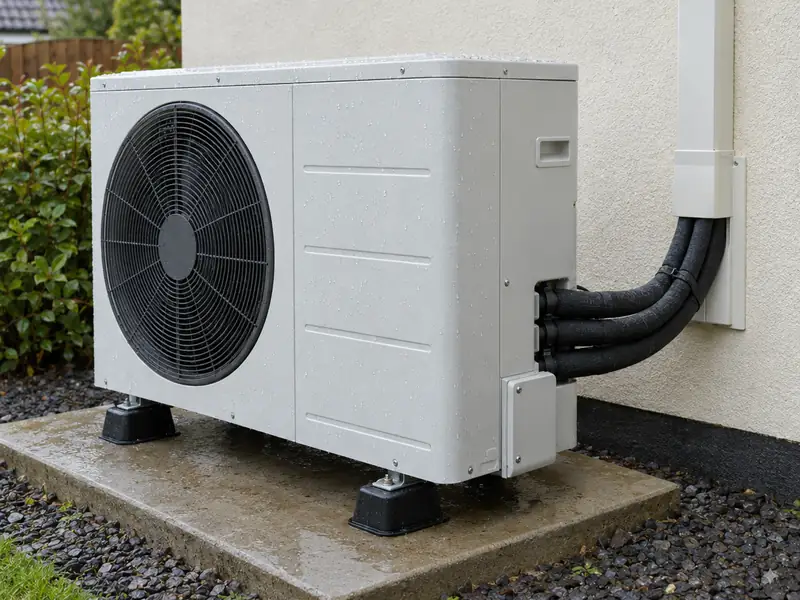
A monobloc heat pump keeps all of its refrigerant sealed inside the outdoor unit and sends heated water into your home, while a split heat pump runs refrigerant pipes from the outdoor unit to an indoor unit, where the heat passes into your heating water. Both are air-to-water heat pumps, and both can heat your radiators, underfloor heating and hot water cylinder.
The choice between them comes down to your home's layout, the distance between the outdoor unit and your heating system, the space you have indoors and how the installation is carried out. This guide sets out the differences, the pros and cons of each and the kinds of home each type tends to suit.
What is a monobloc heat pump?
A monobloc heat pump is a single outdoor unit that contains the whole refrigerant circuit and connects to your home with ordinary water pipes.
The compressor, heat exchangers and refrigerant are filled and sealed in the factory, so no refrigerant work is needed on site. The unit heats water outside, and insulated flow and return pipes carry it through the wall to your cylinder and heating circuit. Many monobloc units use R290 (propane), a natural refrigerant with a very low global warming impact; others use R32.
Because heating water travels outside the house, the pipework between the unit and the wall must be well insulated and protected from frost. The methods used are covered further down this guide.
What is a split heat pump?
A split heat pump has two parts: an outdoor unit with the compressor and fan, and an indoor unit, often called a hydrobox, where heat passes from the refrigerant into your heating water.
The two parts are joined by insulated refrigerant pipes. The indoor unit is usually wall-mounted near the cylinder, roughly the size of a wall-hung boiler, or the hydrobox and cylinder come together in one tall floor-standing unit. Split systems commonly use R32.
Connecting, pressure testing and charging the refrigerant pipes must be done by an F-gas certified engineer. This is a legal requirement for fluorinated refrigerants such as R32, which most split systems use, and it adds a specialist step to the installation.
How do monobloc and split heat pumps compare?
The main differences are where the refrigerant goes, what runs into the house and how much equipment sits indoors.
| Feature | Monobloc | Split |
|---|---|---|
| Refrigerant | Sealed inside the outdoor unit | Circulates between the outdoor and indoor units |
| Pipes into the house | Insulated water pipes | Insulated refrigerant pipes |
| On-site refrigerant work | Not needed | Required, by an F-gas certified engineer |
| Indoor equipment | Cylinder, controls and some hydraulic parts | Indoor unit (hydrobox) plus cylinder, or a combined unit |
| Frost protection | Needed on outdoor water pipework | Heating water stays indoors |
| Distance from the house | Usually kept short to limit heat loss and frost risk | Can be longer, within the manufacturer's limits |
| Common refrigerants | R290 or R32 | Usually R32 |
Guide prices for either type fall within the same typical ranges for a full system, for example £12,000–£15,500 installed including VAT for a three-bedroom semi or small detached house, before any grant. The design your home needs, including radiators and pipework, usually affects the price more than the choice between monobloc and split.
What are the pros and cons of a monobloc heat pump?
A monobloc is usually the simpler installation, with the trade-off that water pipes run outdoors and need careful frost protection.
- No refrigerant work on site, so no F-gas connection work is needed
- Less equipment indoors, which helps where space is tight
- A factory-sealed refrigerant circuit, with no site-made refrigerant joints
- A wide choice of units using R290, a natural refrigerant
Points to weigh up:
- Outdoor water pipes must be insulated, protected from damage and protected from frost
- The unit usually needs to sit close to the wall where pipes enter the house
- Larger-diameter water pipes can be harder to route than slim refrigerant lines
- R290 units have their own clearances from doors, windows and drains
What are the pros and cons of a split heat pump?
A split system gives more flexibility over where the outdoor unit goes, with the trade-off of specialist refrigerant work and more equipment inside.
- Slim refrigerant pipes are easier to route over longer or awkward distances
- No heating water runs outside, so frozen pipework is much less of a concern
- Useful where the outdoor unit has to sit some way from the heating system
Points to weigh up:
- Refrigerant connections must be made by an F-gas certified engineer
- An indoor unit takes up wall or floor space, usually near the cylinder
- Site-made refrigerant joints are checked for leaks at installation and servicing
- Fewer split models use R290
How is monobloc pipework protected from frost?
Monobloc pipework is protected from frost with thick insulation plus at least one of three methods: antifreeze in the water, frost protection valves, or the unit's own frost protection mode.
- Glycol. An antifreeze mixed into the heating water lowers its freezing point. It makes the water slightly less effective at carrying heat, and its strength is checked at servicing.
- Frost protection valves. Valves near the unit open and drain water from the outdoor pipework if it gets close to freezing, so it cannot freeze and split. The system may then need re-pressurising.
- Frost protection mode. The unit runs its pump, and if needed its compressor, to keep water moving when temperatures drop. This relies on the power supply staying on.
Which approach suits depends on the unit, the length of exposed pipe and how exposed the site is. Your quote sets out the method chosen for your home, and the annual service checks that it is still working.
Which homes suit monobloc and which suit split?
Monobloc tends to suit homes where the outdoor unit can sit close to the heating system; split tends to suit homes where the unit has to go further away or outdoor water pipes would be hard to protect.
- Typical monobloc homes: semis, detached houses and bungalows with a garden or side wall next to the utility room, kitchen or wherever the cylinder will go; homes with little spare indoor space; owners who prefer a natural refrigerant.
- Typical split homes: terraces and town houses where the only outdoor space is some distance from the heating system; homes with a long or awkward pipe route; exposed sites where long outdoor water pipes would be a frost risk.
In practice the survey decides. The installer looks at where the unit can go, the pipe route, your indoor space and the noise assessment, then recommends one type and explains why. See monobloc heat pumps and split system heat pumps.
Questions
Is a monobloc or a split heat pump more efficient?
Neither type is automatically more efficient. Seasonal efficiency depends mostly on correct sizing, low flow temperatures, good controls and a sensible position. A monobloc can lose a little heat through long outdoor pipe runs, and glycol carries heat slightly less well than plain water, so keeping pipe runs short matters. A well-designed system of either type commonly reaches a SCOP of about 3–4.
Do monobloc and split heat pumps qualify for the same grants?
Yes. Both are air-to-water heat pumps, so grant schemes treat them the same way. In England and Wales the Boiler Upgrade Scheme gives £7,500, applied for by the MCS-certified installer. In Scotland, Home Energy Scotland offers a grant of up to £7,500. Northern Ireland has no dedicated heat pump grant for homeowners at present.
Who can install a split heat pump?
Split systems usually use a fluorinated refrigerant such as R32, so work on their refrigerant circuit must by law be done by an F-gas certified engineer. The plumbing and electrical work is carried out by suitably qualified trades. Your quote names the MCS-certified installer for your job, which matters if you are claiming a grant.
Does a split heat pump need an indoor unit?
Yes. A split heat pump needs an indoor unit, often called a hydrobox, where heat passes from the refrigerant into your heating water. It is usually wall-mounted near the hot water cylinder and is roughly the size of a wall-hung boiler, or it is combined with the cylinder in one tall unit. A monobloc does not need one.
Sources
Scheme figures and price cap rates checked October 2026.