
- Area
- County Armagh
- Postcode district
- BT61
- Nation
- Northern Ireland
- Guide price
- Priced after survey
- Survey
- Free for installation enquiries
Before you book: heat loss surveys in Armagh
Homes around Armagh range from older terraces to newer estates, and each needs a different design. That is why we survey before we quote.
Design outdoor temperatures for Armagh and the wider County Armagh come from local cold-weather data, not a national average. For Armagh homes with extensions or loft conversions, each part of the house is assessed on its own construction.
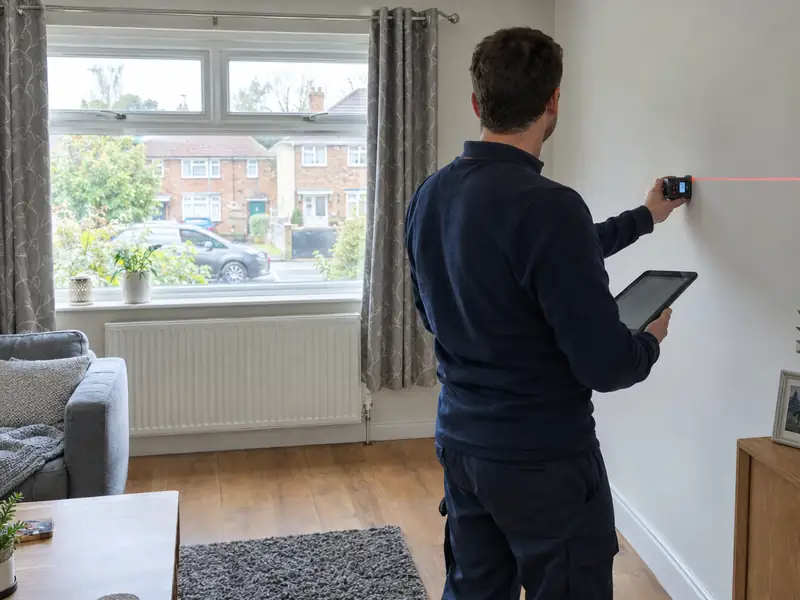
Every heat pump we quote starts with a room-by-room heat loss survey, free with installation enquiries and also available as a stand-alone report.
- Anyone getting a heat pump quote, as the first step
- Self-builders and architects who need emitter and system sizes early
- Homeowners planning insulation or building work who want to know the effect on heat demand
What's included
- Recommended heat pump size and design flow temperature
- Hot water cylinder sizing for your household
- Written results in your quote, or a stand-alone report if you order one
- Room-by-room heat loss calculation using the MCS method
- Outdoor unit siting options and noise check
Houses in Armagh built in different eras can need very different heat pump sizes, which is why each is calculated room by room.
Grants and rules for heat pumps in Northern Ireland
The Boiler Upgrade Scheme covers England and Wales only, and there is currently no dedicated heat pump grant for homeowners in Northern Ireland. Our quote for an Armagh home is therefore shown without a grant deduction; if support becomes available we will tell you how it applies.
There is no VAT on installing a heat pump in Northern Ireland until 31 March 2027, the same as in Great Britain. Planning and building control here follow Northern Ireland's own rules, so the survey checks the unit position against them.
Guide prices for heat loss surveys in Armagh
These are guide prices for County Armagh, installed and including VAT. Your final price is fixed in a written quote after the survey and depends on the heat loss of the house, the radiators that need changing and where the unit goes.
| Survey | Guide price |
|---|---|
| Home survey and heat loss calculation with an installation quote | Free |
| Stand-alone heat loss survey and report | £150–£390 |
Inc VAT. A stand-alone report is for homeowners who want the design without an installation quote.
How long is the heating season in Armagh?
Armagh sees roughly 7 hours 18 minutes of daylight in December and 17 hours 13 minutes in June. With a longer heating season than the south, the gains from low flow temperatures and good controls add up over the year.
What happens after you enquire in Armagh?
- Send your postcode and a few details, or use the guide price tool.
- A surveyor visits your Armagh home, measures every room and checks where the outdoor unit can go.
- You receive a heat loss design and a fixed written quote, with any grant shown where it applies.
- Installers fit the unit, cylinder and any radiator changes, typically over 2–4 days on site.
- The system is commissioned, set up with weather compensation and handed over with the paperwork.
Heat loss surveys in Armagh: questions
How soon can you survey a home in Armagh?
Survey dates depend on how busy installers are in County Armagh. We offer the next available dates when you enquire and confirm them in writing.
Do you cover Keady as well as Armagh?
Yes. We arrange surveys and installation in Keady, which is about 7 miles south of Armagh, and across County Armagh.
How long does a heat pump survey take in Armagh?
A home survey in Armagh usually takes one to two hours. The surveyor measures every heated room, checks windows, walls and radiators, and looks at where the outdoor unit and cylinder can go.
What is a design flow temperature?
The design flow temperature is the temperature of the water sent to your radiators or underfloor heating on the coldest design day. Heat pumps are more efficient at lower flow temperatures, typically around 35–50°C. Choosing it is a balance: a lower figure improves efficiency but can mean larger radiators in some rooms, so the design shows both.
How long does a heat loss survey take?
A typical survey takes 1–3 hours on site, depending on the size and complexity of the home. Larger or older houses with mixed construction, extensions or many rooms take longer. The calculations and design are completed afterwards, and the results are included in your quote or stand-alone report.