
- Area
- Devon
- Postcode district
- TQ6
- Nation
- England
- Guide price
- Priced after survey
- Survey
- Free for installation enquiries
Before you book: heat loss surveys in Dartmouth
Most homes can run on a heat pump if the system is designed properly, and Dartmouth is no different. The key is matching the heat pump and radiators to the home's heat loss.
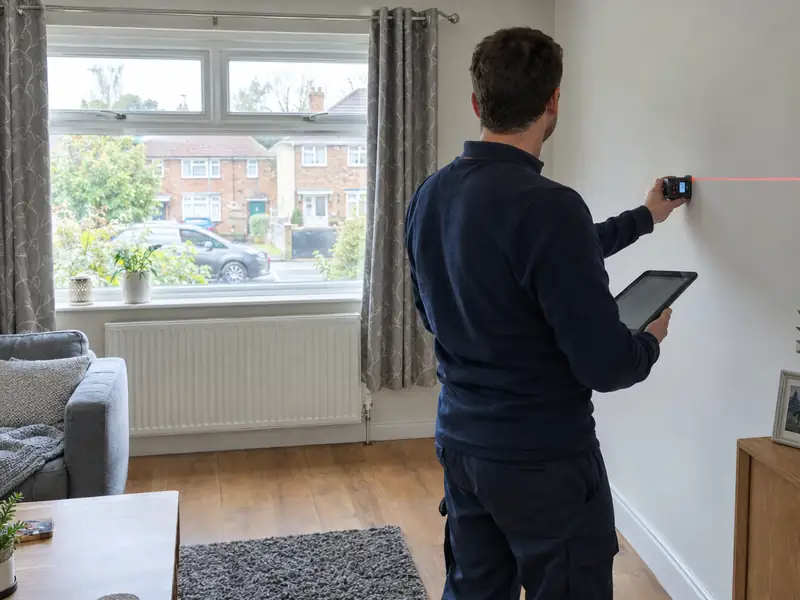
The survey in Dartmouth includes a check of where the outdoor unit could sit and how its sound would reach neighbours. A surveyor visits your Dartmouth home to measure each room, window and wall before any heat pump is sized.
Every heat pump we quote starts with a room-by-room heat loss survey, free with installation enquiries and also available as a stand-alone report.
- Anyone getting a heat pump quote, as the first step
- Homeowners planning insulation or building work who want to know the effect on heat demand
- Self-builders and architects who need emitter and system sizes early
What's included
- Written results in your quote, or a stand-alone report if you order one
- Electrical supply and network operator notes
- Outdoor unit siting options and noise check
- Recommended heat pump size and design flow temperature
- Radiator schedule with any upgrades needed for each room
For Dartmouth homes with extensions or loft conversions, each part of the house is assessed on its own construction.
Grants and rules for heat pumps in England
In England the Boiler Upgrade Scheme gives £7,500 towards an air source heat pump (£9,000 if it replaces oil or LPG, from 21 July 2026 to 31 March 2027), and since 28 April 2026 a valid EPC is no longer needed. The grant is applied for by the MCS-certified installer and shown as a deduction on your Dartmouth quote.
Installing heat pumps is zero-rated for VAT across the UK until 31 March 2027. Since 29 May 2025, permitted development in England allows up to two air source heat pumps on a house, each up to 1.5 m³, with no blanket 1 m boundary rule — the installation must still meet the MCS planning standards, including the noise check. Listed buildings, flats and some conservation-area positions need extra consent, which we check at survey.
What to budget for heat loss surveys in Dartmouth
Here are typical prices for heat loss surveys in Devon, installed and including VAT. Use the guide price tool for a figure based on your home, then a survey confirms it in writing.
| Survey | Guide price |
|---|---|
| Home survey and heat loss calculation with an installation quote | Free |
| Stand-alone heat loss survey and report | £150–£400 |
Inc VAT. A stand-alone report is for homeowners who want the design without an installation quote.
Short winter days in Dartmouth and what they mean
On the shortest day Dartmouth gets about 8 hours 01 minutes of daylight, and the winter sun reaches only around 16° above the horizon at noon. Winters this far south are milder than in most of the UK, which helps a heat pump run at low flow temperatures for much of the season.
From survey to switch-on in Dartmouth
- Send your postcode and a few details, or use the guide price tool.
- A surveyor visits your Dartmouth home, measures every room and checks where the outdoor unit can go.
- You receive a heat loss design and a fixed written quote, with any grant shown where it applies.
- Installers fit the unit, cylinder and any radiator changes, typically over 2–4 days on site.
- The system is commissioned, set up with weather compensation and handed over with the paperwork.
Heat loss surveys in Dartmouth: questions
How long does installation take in Dartmouth?
Most installations take 2–4 days on site. Jobs with several radiator changes or new pipework take longer, and your quote for a Dartmouth home states the expected time.
What size heat pump does a Dartmouth home need?
It depends on the heat loss, not the postcode. As a rough guide, a 3 bedroom semi often needs 6–9 kW, but the room-by-room survey sets the actual size for your Dartmouth home.
How long does a heat pump survey take in Dartmouth?
A home survey in Dartmouth usually takes one to two hours. The surveyor measures every heated room, checks windows, walls and radiators, and looks at where the outdoor unit and cylinder can go.
What is a design flow temperature?
The design flow temperature is the temperature of the water sent to your radiators or underfloor heating on the coldest design day. Heat pumps are more efficient at lower flow temperatures, typically around 35–50°C. Choosing it is a balance: a lower figure improves efficiency but can mean larger radiators in some rooms, so the design shows both.
How long does a heat loss survey take?
A typical survey takes 1–3 hours on site, depending on the size and complexity of the home. Larger or older houses with mixed construction, extensions or many rooms take longer. The calculations and design are completed afterwards, and the results are included in your quote or stand-alone report.