
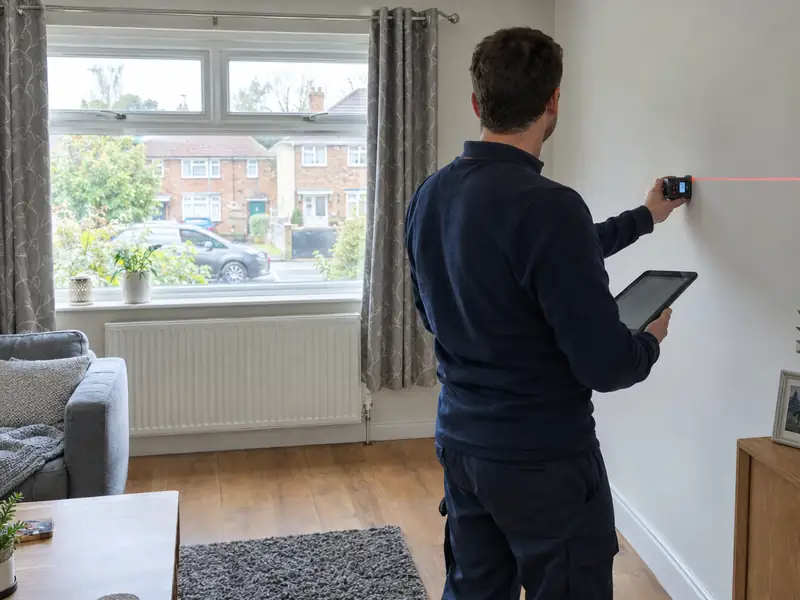
A heat loss survey is a room-by-room assessment that calculates how much heat your home loses on a cold day, which tells you what size of heat pump you need and whether your radiators can deliver enough warmth. It follows the MCS method, the standard used for heat pump design across the UK, and it is the foundation for every other decision in your quote.
The survey in Dyfed includes a check of where the outdoor unit could sit and how its sound would reach neighbours. For Dyfed homes with extensions or loft conversions, each part of the house is assessed on its own construction. Houses in Dyfed built in different eras can need very different heat pump sizes, which is why each is calculated room by room.
Who it suits
- Homeowners planning insulation or building work who want to know the effect on heat demand
- Self-builders and architects who need emitter and system sizes early
- Homes with an existing heat pump that seems undersized or expensive to run
- Anyone getting a heat pump quote, as the first step
Grants and rules for heat pumps in Wales
In Wales the Boiler Upgrade Scheme gives £7,500 towards an air source heat pump (£9,000 if it replaces oil or LPG, from 21 July 2026 to 31 March 2027; £2,500 for air-to-air). The MCS-certified installer named in your quote applies to Ofgem for you, and the grant comes off your quote.
Installing heat pumps is zero-rated for VAT across the UK until 31 March 2027. Wales has its own permitted development rules for air source heat pumps, so we check what applies to your property, including listed building and conservation-area constraints, at the survey.
Heat loss survey prices in Dyfed
These are guide prices for Dyfed, installed and including VAT. Your final price is fixed in a written quote after the survey and depends on the heat loss of the house, the radiators that need changing and where the unit goes.
| Survey | Guide price |
|---|---|
| Home survey and heat loss calculation with an installation quote | Free |
| Stand-alone heat loss survey and report | £150–£400 |
Inc VAT. A stand-alone report is for homeowners who want the design without an installation quote.
Towns we cover in Dyfed
We cover 11 towns in Dyfed for heat loss surveys. Each links to local guide prices and the grant position for Wales.
| Town | Postcode district | Nearest town | Midwinter daylight |
|---|---|---|---|
| Llanelli | SA15 | Gorseinon | 7 h 48 min |
| Ammanford | SA18 | Pontardawe | 7 h 47 min |
| Aberystwyth | SY23 | Machynlleth | 7 h 40 min |
| Carmarthen | SA31 | Llanelli | 7 h 46 min |
| Cardigan | SA43 | Fishguard | 7 h 44 min |
| Fishguard | SA65 | Haverfordwest | 7 h 44 min |
| Haverfordwest | SA61 | Milford Haven | 7 h 46 min |
| Lampeter | SA48 | Carmarthen | 7 h 43 min |
| Milford Haven | SA73 | Pembroke Dock | 7 h 47 min |
| Pembroke Dock | SA72 | Milford Haven | 7 h 48 min |
| Tenby | SA70 | Pembroke Dock | 7 h 48 min |
Heat loss surveys questions
Why can't you size the heat pump from my boiler?
Boilers are often much larger than a home's real heat loss, because they are sized for fast hot water and quick warm-ups. Matching a heat pump to the boiler's output usually means an oversized unit that costs more and switches on and off too often. A room-by-room calculation finds the actual heat demand, which is what the heat pump needs to meet.
What is a design flow temperature?
The design flow temperature is the temperature of the water sent to your radiators or underfloor heating on the coldest design day. Heat pumps are more efficient at lower flow temperatures, typically around 35–50°C. Choosing it is a balance: a lower figure improves efficiency but can mean larger radiators in some rooms, so the design shows both.
Will the survey check noise from the outdoor unit?
Yes. The surveyor identifies possible positions for the outdoor unit and carries out the MCS noise assessment, which estimates the sound level at the nearest neighbouring window from the unit's sound power level, distance and any barriers. In England, meeting the MCS planning standards is one of the conditions for permitted development. Wales, Scotland and Northern Ireland have their own rules, which we check.
Can I use the heat loss report to get other quotes?
Yes. A stand-alone heat loss report is yours to use, including sharing it with other installers so their quotes are based on the same figures. Comparing quotes like for like makes it easier to see differences in equipment, radiator upgrades and workmanship terms. The report states the assumptions used wherever construction could not be confirmed.