
- Area
- Gloucestershire
- Postcode district
- GL7
- Nation
- England
- Guide price
- Priced after survey
- Survey
- Free for installation enquiries
Heat loss survey in Cirencester: what to expect
In Cirencester, as anywhere in the UK, the heat pumps that perform well are the ones designed around low flow temperatures and sized from a proper heat loss calculation.
Homeowners in Cirencester thinking about insulation work can use the survey to see how it would change their heat pump size. Houses in Cirencester built in different eras can need very different heat pump sizes, which is why each is calculated room by room.
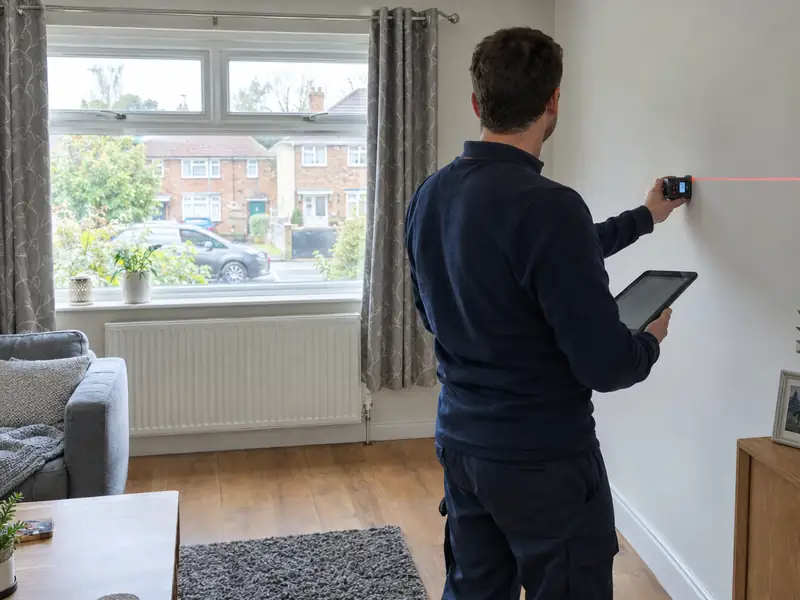
Every heat pump we quote starts with a room-by-room heat loss survey, free with installation enquiries and also available as a stand-alone report.
- Landlords comparing properties before deciding where to switch first
- Anyone getting a heat pump quote, as the first step
- Homeowners planning insulation or building work who want to know the effect on heat demand
What's included
- Room-by-room heat loss calculation using the MCS method
- Radiator schedule with any upgrades needed for each room
- Electrical supply and network operator notes
- Written results in your quote, or a stand-alone report if you order one
- Recommended heat pump size and design flow temperature
For Cirencester homes with extensions or loft conversions, each part of the house is assessed on its own construction.
Grants and rules for heat pumps in England
In England the Boiler Upgrade Scheme gives £7,500 towards an air source heat pump (£9,000 if it replaces oil or LPG, from 21 July 2026 to 31 March 2027), and since 28 April 2026 a valid EPC is no longer needed. The grant is applied for by the MCS-certified installer and shown as a deduction on your Cirencester quote.
There is no VAT on installing a heat pump anywhere in the UK until 31 March 2027. In England most houses can have an air source heat pump under permitted development, provided the unit meets the MCS noise and siting standards; the old 1 m boundary limit was removed on 29 May 2025. We flag listed buildings, flats and sensitive conservation-area positions at survey.
Heat loss survey prices in Cirencester
The ranges below are typical installed prices for homes in Gloucestershire, including VAT. A survey sets the exact figure, because two similar-looking houses in Cirencester can need quite different radiators and pipework.
| Survey | Guide price |
|---|---|
| Home survey and heat loss calculation with an installation quote | Free |
| Stand-alone heat loss survey and report | £150–£400 |
Inc VAT. A stand-alone report is for homeowners who want the design without an installation quote.
Designing for Cirencester's winters
Cirencester has about 7 hours 47 minutes of daylight at midwinter and 16 hours 41 minutes at midsummer. That swing matters if you pair a heat pump with solar panels: summer generation can cover much of the hot water, winter generation far less.
From survey to switch-on in Cirencester
- Start online with a guide price or call us.
- A home survey in Cirencester gives us the room-by-room heat loss.
- Your written quote sets out the design, the price and the grant position where you live.
- Installation is booked for dates that suit you; most homes take 2–4 days on site.
- After commissioning you get a handover of the controls and settings, plus the certificates.
Heat loss surveys in Cirencester: questions
Do you cover Stroud as well as Cirencester?
Yes. We arrange surveys and installation in Stroud, which is about 10 miles west of Cirencester, and across Gloucestershire.
What size heat pump does a Cirencester home need?
It depends on the heat loss, not the postcode. As a rough guide, a 3 bedroom semi often needs 6–9 kW, but the room-by-room survey sets the actual size for your Cirencester home.
How soon can you survey a home in Cirencester?
Survey dates depend on how busy installers are in Gloucestershire. We offer the next available dates when you enquire and confirm them in writing.
Can I use the heat loss report to get other quotes?
Yes. A stand-alone heat loss report is yours to use, including sharing it with other installers so their quotes are based on the same figures. Comparing quotes like for like makes it easier to see differences in equipment, radiator upgrades and workmanship terms. The report states the assumptions used wherever construction could not be confirmed.
What is a design flow temperature?
The design flow temperature is the temperature of the water sent to your radiators or underfloor heating on the coldest design day. Heat pumps are more efficient at lower flow temperatures, typically around 35–50°C. Choosing it is a balance: a lower figure improves efficiency but can mean larger radiators in some rooms, so the design shows both.