
- Area
- Glasgow and Dunbartonshire
- Postcode district
- G81
- Nation
- Scotland
- Guide price
- From £250 inc VAT
- Survey
- Free for installation enquiries
Heat pump radiators in Clydebank: what to expect
Homes around Clydebank range from older terraces to newer estates, and each needs a different design. That is why we survey before we quote.
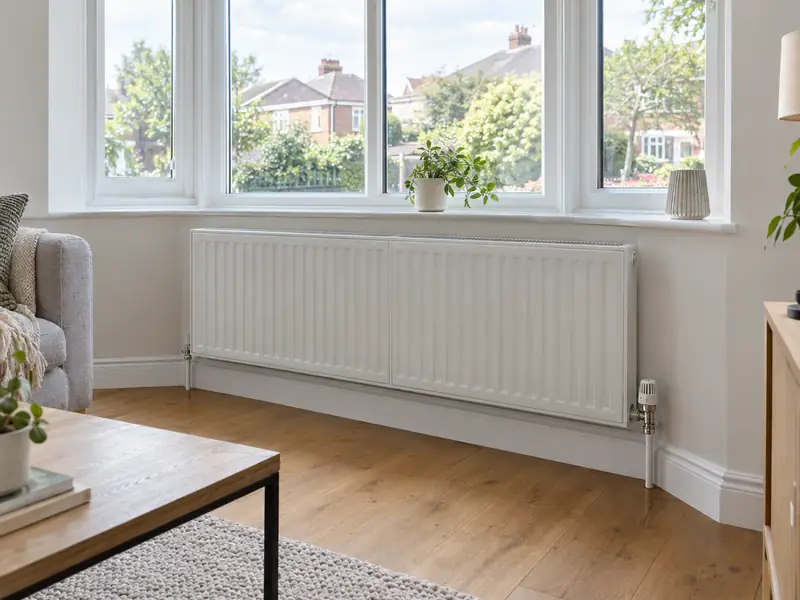
Many older houses in Clydebank still have their original single-panel radiators, so the survey checks each one against the room it heats. In Clydebank, bay-windowed front rooms are often the rooms that need a larger radiator when moving to a heat pump.
We size each radiator to your room-by-room heat loss so a heat pump can heat your home at a low, efficient flow temperature.
- Homes switching from a gas, oil or LPG boiler to a heat pump
- Rooms that already feel slow to heat, such as bay-windowed living rooms
- Homeowners who want the lowest practical flow temperature for efficiency
What's included
- A radiator schedule showing which radiators stay, which change and their outputs
- Making good around brackets and pipe routes, with any decorating agreed in your quote
- Room-by-room heat loss figures for every heated room
- Pipework checks and any agreed pipe upgrades
- Supply and fitting of new radiators, valves and brackets
For period homes in Clydebank and across Glasgow and Dunbartonshire, column radiators can keep the character of a room while giving enough heat at low temperatures.
Grants and rules for heat pumps in Scotland
The Boiler Upgrade Scheme does not apply in Scotland. Instead, homeowners in Clydebank can apply to Home Energy Scotland for a grant of up to £7,500 towards a heat pump, with up to £1,500 more for eligible rural and island homes, plus an optional interest-free loan of up to £7,500. You need a written funding offer before any work starts.
Installing heat pumps is zero-rated for VAT across the UK until 31 March 2027. Scotland has its own permitted development rules for air source heat pumps and its own building standards, so we confirm what applies to your Clydebank property at survey.
Heat pump radiators prices in Clydebank
The ranges below are typical installed prices for homes in Glasgow and Dunbartonshire, including VAT. A survey sets the exact figure, because two similar-looking houses in Clydebank can need quite different radiators and pipework.
| Work | Guide price |
|---|---|
| Replacement radiator, sized for a heat pump (each, fitted) | £250–£450 |
| Upgrade of about 10 radiators | £2,000–£5,000 |
| Pipework upgrade (e.g. microbore to larger bore) | £1,500–£3,500 |
Installed, inc VAT. The survey lists which radiators need changing.
Winter daylight and heating in Clydebank
Clydebank has about 6 hours 58 minutes of daylight at midwinter against 17 hours 36 minutes in midsummer. Heat pumps are designed to keep working well below freezing, but the design temperature for the survey is set for local conditions, not an average day.
How installation works in Clydebank
- Start online with a guide price or call us.
- A home survey in Clydebank gives us the room-by-room heat loss.
- Your written quote sets out the design, the price and the grant position where you live.
- Installation is booked for dates that suit you; most homes take 2–4 days on site.
- After commissioning you get a handover of the controls and settings, plus the certificates.
Heat pump radiator upgrades in Clydebank: questions
Do you cover Bearsden as well as Clydebank?
Yes. We arrange surveys and installation in Bearsden, which is about 3 miles east of Clydebank, and across Glasgow and Dunbartonshire.
Can you service a heat pump in Clydebank that someone else installed?
Yes. We arrange servicing and repairs for most air source heat pumps in Clydebank, whoever fitted them. Tell us the make and model when you book.
What size heat pump does a Clydebank home need?
It depends on the heat loss, not the postcode. As a rough guide, a 3 bedroom semi often needs 6–9 kW, but the room-by-room survey sets the actual size for your Clydebank home.
Can I keep my radiators and just run the heat pump hotter?
You can, but it usually costs more to run. Every extra degree of flow temperature reduces a heat pump's efficiency, so a system designed at 55°C uses noticeably more electricity than one at 45°C for the same heat. A few well-chosen radiator upgrades often let the whole house run cooler, which is the better long-term trade.
Do I need new radiators for a heat pump?
Not necessarily: many homes keep most of their radiators and replace only a few. The heat loss survey checks each room against its existing radiator at the planned flow temperature. Rooms with large windows, high ceilings or extensions are the usual candidates for an upgrade, while bedrooms often need no change. Your radiator schedule lists every decision.