
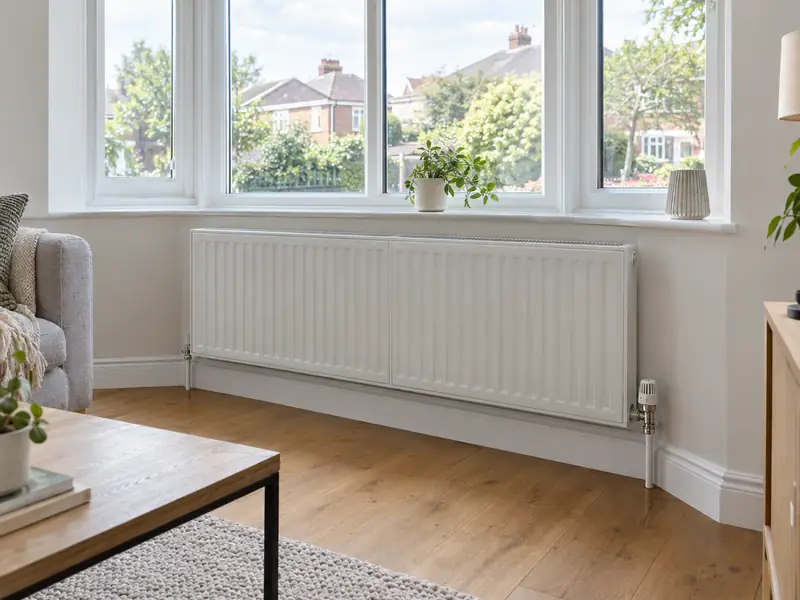
A heat pump radiator upgrade means replacing only the radiators that are too small to heat their room at the lower water temperatures a heat pump runs at. A gas boiler usually sends water to radiators at 60–75°C, while a well-designed heat pump system typically runs at around 35–50°C. Cooler water gives out less heat from the same radiator, so some rooms need more radiator surface to stay comfortable.
Extensions and kitchen-diners around Gwynedd with large glazed areas get their own radiator calculation. In Gwynedd, bay-windowed front rooms are often the rooms that need a larger radiator when moving to a heat pump. Radiator fitting in Gwynedd is scheduled with your heat pump installation so the system is drained only once.
Who it suits
- Homeowners who want the lowest practical flow temperature for efficiency
- Homes switching from a gas, oil or LPG boiler to a heat pump
- Rooms that already feel slow to heat, such as bay-windowed living rooms
- Rooms with little wall space, where a fan-assisted radiator fits better
Grants and rules for heat pumps in Wales
Homes in Gwynedd can use the Boiler Upgrade Scheme, which applies in Wales as well as England: £7,500 towards an air source heat pump, or £9,000 when it replaces oil or LPG heating for installations from 21 July 2026 to 31 March 2027. The MCS-certified installer named in your quote applies and deducts the grant.
There is no VAT on installing a heat pump anywhere in the UK, Wales included, until 31 March 2027. Planning rules for heat pumps in Wales are set by the Welsh Government and differ from England's, so the surveyor checks the unit position against them.
Heat pump radiators prices in Gwynedd
These are guide prices for Gwynedd, installed and including VAT. Your final price is fixed in a written quote after the survey and depends on the heat loss of the house, the radiators that need changing and where the unit goes.
| Work | Guide price |
|---|---|
| Replacement radiator, sized for a heat pump (each, fitted) | £250–£450 |
| Upgrade of about 10 radiators | £2,000–£5,000 |
| Pipework upgrade (e.g. microbore to larger bore) | £1,500–£3,500 |
Installed, inc VAT. The survey lists which radiators need changing.
Towns we cover in Gwynedd
We cover 9 towns in Gwynedd for heat pump radiator upgrades. Each links to local guide prices and the grant position for Wales.
| Town | Postcode district | Nearest town | Midwinter daylight |
|---|---|---|---|
| Bangor (Gwynedd) | LL59 | Beaumaris | 7 h 31 min |
| Bala | LL23 | Dolgellau | 7 h 35 min |
| Beaumaris | LL58 | Bangor (Gwynedd) | 7 h 31 min |
| Caernarfon | LL55 | Llangefni | 7 h 32 min |
| Dolgellau | LL40 | Machynlleth | 7 h 36 min |
| Holyhead | LL65 | Llangefni | 7 h 30 min |
| Llangefni | LL77 | Bangor (Gwynedd) | 7 h 31 min |
| Porthmadog | LL49 | Pwllheli | 7 h 34 min |
| Pwllheli | LL53 | Porthmadog | 7 h 35 min |
Heat pump radiator upgrades questions
Will new radiators be much bigger than my old ones?
Sometimes, but not always. Swapping a single-panel radiator for a double or triple-panel model of the same height and width can raise output substantially, adding only depth from the wall. Where that is not enough, a longer or taller radiator, or a second radiator in the room, may be needed. We agree sizes and positions with you before anything is ordered.
Are fan-assisted radiators noisy?
Fan-assisted radiators make a low, steady fan sound when running at higher output, and many have quieter settings for bedrooms at night. They are useful where wall space is short, such as a kitchen with few clear walls. They need a small electrical supply, which we plan into the installation if you choose them.
How much does a heat pump radiator cost?
A replacement radiator sized for a heat pump has a guide price of £250–£450 each, installed and including VAT. Upgrading about ten radiators in a typical home has a guide price of £2,000–£5,000. The final price is fixed in your written quote after the survey, once the radiator schedule shows exactly which radiators change.
Can I keep my radiators and just run the heat pump hotter?
You can, but it usually costs more to run. Every extra degree of flow temperature reduces a heat pump's efficiency, so a system designed at 55°C uses noticeably more electricity than one at 45°C for the same heat. A few well-chosen radiator upgrades often let the whole house run cooler, which is the better long-term trade.