
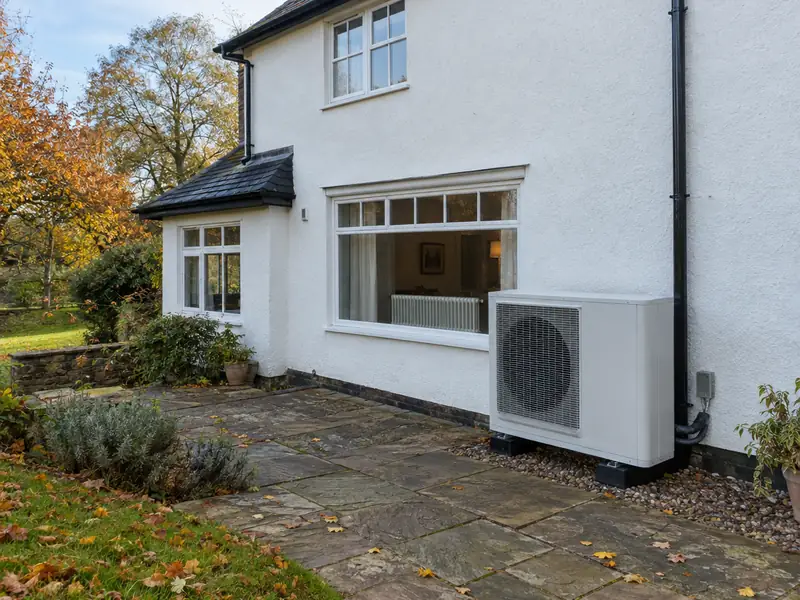
This suits homes where changing radiators is hard: period and listed properties with cast-iron radiators or fragile finishes, homes with microbore pipework that is difficult to replace, and rooms with no space for a larger radiator. Many of these units use R290 (propane), a natural refrigerant that makes higher water temperatures more achievable than some earlier refrigerants did.
Older homes around Angus and Dundee often need a discreet unit position, such as a rear courtyard, which the survey looks for first. In Angus and Dundee, rooms with large bay windows are often the ones where radiator output is checked most carefully. Installers in Angus and Dundee set the weather compensation curve so the unit runs cooler on mild days.
Who it suits
- Rooms with no wall space for a larger radiator
- Homes with microbore pipework that would be disruptive to replace
- Period and listed homes where the radiators are part of the character
- Owners who want fewer changes inside the house
Grants and rules for heat pumps in Scotland
In Scotland, heat pump funding comes through Home Energy Scotland rather than the Boiler Upgrade Scheme: a grant of up to £7,500 (up to £1,500 extra for eligible rural and island homes) and an optional interest-free loan of up to £7,500. For a home in Angus and Dundee, apply and receive the written offer before the installation date is fixed.
There is no VAT on installing a heat pump anywhere in the UK, Scotland included, until 31 March 2027. Scottish permitted development rules and building standards apply, and the surveyor checks the unit position and any listed or conservation-area constraints.
High-temperature heat pumps prices in Angus and Dundee
The ranges below are typical installed prices for homes in Angus and Dundee, including VAT. A survey sets the exact figure, because two similar-looking houses in Angus and Dundee can need quite different radiators and pipework.
| Home | Typical size | Installed guide price |
|---|---|---|
| 1–2 bedroom flat or small terrace | 4–5 kW | £9,500–£12,500 |
| 2–3 bedroom terrace or semi | 5–7 kW | £10,500–£13,500 |
| 3 bedroom semi or small detached | 6–9 kW | £12,000–£15,500 |
| 4 bedroom detached | 8–12 kW | £14,000–£18,000 |
| 5+ bedroom or larger older house | 11–16 kW | £16,500–£22,500 |
Installed, inc VAT: unit, cylinder, controls, minor pipework and commissioning. A high-temperature unit typically adds £1,500–£3,000. In Scotland, Home Energy Scotland grants of up to £7,500 and interest-free loans may reduce the cost.
Towns we cover in Angus and Dundee
We cover 8 towns in Angus and Dundee for high-temperature heat pumps. Each links to local guide prices and the grant position for Scotland.
| Town | Postcode district | Nearest town | Midwinter daylight |
|---|---|---|---|
| Dundee | DD1 | Monifieth | 6 h 50 min |
| Arbroath | DD11 | Carnoustie | 6 h 49 min |
| Brechin | DD9 | Montrose | 6 h 46 min |
| Carnoustie | DD7 | Monifieth | 6 h 50 min |
| Forfar | DD8 | Kirriemuir | 6 h 48 min |
| Kirriemuir | DD8 | Forfar | 6 h 47 min |
| Monifieth | DD5 | Carnoustie | 6 h 50 min |
| Montrose | DD10 | Brechin | 6 h 47 min |
High-temperature heat pumps questions
Are high-temperature heat pumps eligible for the grant?
In England and Wales, yes. A high-temperature unit is an air-to-water heat pump, so eligible owners of existing homes can receive £7,500 through the Boiler Upgrade Scheme, or £9,000 when replacing oil or LPG within the published dates. Scotland's Home Energy Scotland funding has its own conditions, and Northern Ireland has no dedicated homeowner grant at present.
Why do many high-temperature units use R290?
R290 is propane, a natural refrigerant with a very low global warming impact. Its properties make higher water temperatures more achievable than with some earlier refrigerants. Because it is flammable, manufacturers set clearance zones around the outdoor unit from windows, doors, drains and other openings, which the survey uses when choosing a position.
Are high-temperature heat pumps less efficient?
Yes, when they run hot. Every heat pump uses more electricity per unit of heat as the flow temperature rises, so a unit running at 70°C is less efficient than one running at 45°C. With weather compensation it runs cooler for much of the year, which narrows the gap. The design aims to keep the maximum temperature as low as your radiators allow.
Do I still need a hot water cylinder?
Yes. Like other air-to-water heat pumps, a high-temperature unit heats a stored cylinder rather than supplying hot water on demand. Its higher output temperature can help the cylinder reach the temperature needed for its periodic legionella cycle with less reliance on the immersion heater. The cylinder is sized for your household at survey.