
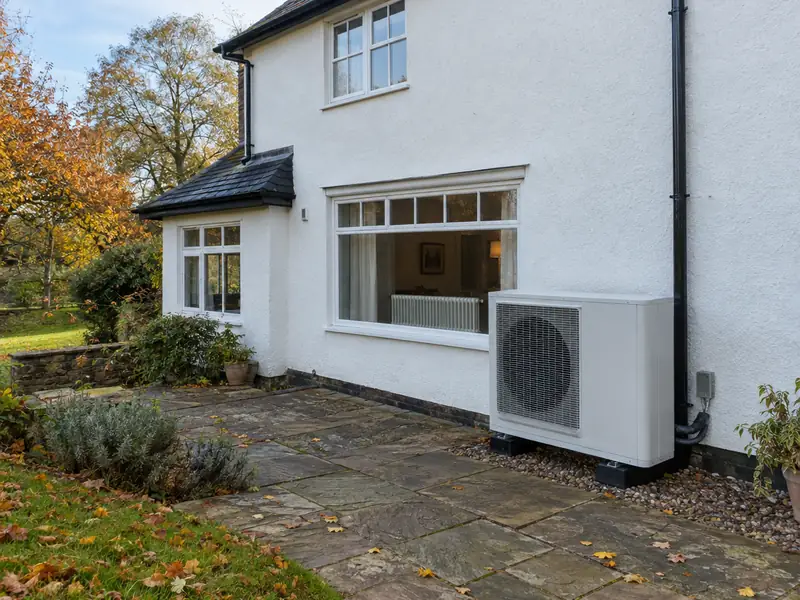
This suits homes where changing radiators is hard: period and listed properties with cast-iron radiators or fragile finishes, homes with microbore pipework that is difficult to replace, and rooms with no space for a larger radiator. Many of these units use R290 (propane), a natural refrigerant that makes higher water temperatures more achievable than some earlier refrigerants did.
Period houses in Greater Manchester with original cast-iron radiators may suit a high-temperature unit that works with them. For older Greater Manchester homes with microbore pipework, a higher flow temperature can avoid lifting floors to replace pipes. Installers in Greater Manchester set the weather compensation curve so the unit runs cooler on mild days.
Who it suits
- Older homes where insulation improvements are limited
- Homes with microbore pipework that would be disruptive to replace
- Period and listed homes where the radiators are part of the character
- Owners who want fewer changes inside the house
Grants and rules for heat pumps in England
In England the Boiler Upgrade Scheme gives £7,500 towards an air source heat pump (£9,000 if it replaces oil or LPG, from 21 July 2026 to 31 March 2027), and since 28 April 2026 a valid EPC is no longer needed. The grant is applied for by the MCS-certified installer and shown as a deduction on your quote.
Installing heat pumps is zero-rated for VAT across the UK until 31 March 2027. Since 29 May 2025, permitted development in England allows up to two air source heat pumps on a house, each up to 1.5 m³, with no blanket 1 m boundary rule — the installation must still meet the MCS planning standards, including the noise check. Listed buildings, flats and some conservation-area positions need extra consent, which we check at survey.
High-temperature heat pumps prices in Greater Manchester
Here are typical prices for high-temperature heat pumps in Greater Manchester, installed and including VAT. Use the guide price tool for a figure based on your home, then a survey confirms it in writing.
| Home | Typical size | Installed guide price | After £7,500 grant |
|---|---|---|---|
| 1–2 bedroom flat or small terrace | 4–5 kW | £9,300–£12,250 | £1,800–£4,750 |
| 2–3 bedroom terrace or semi | 5–7 kW | £10,300–£13,250 | £2,800–£5,750 |
| 3 bedroom semi or small detached | 6–9 kW | £11,750–£15,200 | £4,250–£7,700 |
| 4 bedroom detached | 8–12 kW | £13,700–£17,650 | £6,200–£10,150 |
| 5+ bedroom or larger older house | 11–16 kW | £16,150–£22,050 | £8,650–£14,550 |
Installed, inc VAT: unit, cylinder, controls, minor pipework and commissioning. A high-temperature unit typically adds £1,500–£3,000.
Towns we cover in Greater Manchester
We cover 29 towns in Greater Manchester for high-temperature heat pumps. Each links to local guide prices and the grant position for England.
| Town | Postcode district | Nearest town | Midwinter daylight |
|---|---|---|---|
| Manchester | M2 | Stretford | 7 h 28 min |
| Oldham | OL1 | Middleton | 7 h 27 min |
| Wigan | WN1 | Golborne | 7 h 27 min |
| Bolton | BL1 | Radcliffe | 7 h 27 min |
| Stockport | SK1 | Denton | 7 h 29 min |
| Rochdale | OL16 | Heywood | 7 h 27 min |
| Sale | M33 | Stretford | 7 h 29 min |
| Bury | BL9 | Radcliffe | 7 h 27 min |
| Altrincham | WA14 | Sale | 7 h 29 min |
| Middleton | M24 | Heywood | 7 h 27 min |
| Ashton-under-Lyne | OL7 | Denton | 7 h 28 min |
| Leigh | WN7 | Atherton | 7 h 28 min |
| Stretford | M32 | Urmston | 7 h 29 min |
| Urmston | M41 | Stretford | 7 h 29 min |
| Eccles | M30 | Swinton | 7 h 28 min |
| Tyldesley | M29 | Atherton | 7 h 28 min |
| Hyde | SK14 | Denton | 7 h 29 min |
| Walkden | M28 | Swinton | 7 h 28 min |
| Prestwich | M25 | Whitefield | 7 h 28 min |
| Radcliffe | M26 | Whitefield | 7 h 27 min |
| Heywood | OL10 | Middleton | 7 h 27 min |
| Denton | M34 | Hyde | 7 h 28 min |
| Saddleworth | OL3 | Oldham | 7 h 27 min |
| Golborne | WA12 | Leigh | 7 h 28 min |
| Whitefield | M45 | Radcliffe | 7 h 27 min |
| Swinton | M27 | Eccles | 7 h 28 min |
| Atherton | M46 | Tyldesley | 7 h 28 min |
| Irlam | M44 | Urmston | 7 h 29 min |
| Horwich | BL6 | Bolton | 7 h 27 min |
High-temperature heat pumps questions
Is a high-temperature heat pump right for a listed building?
It can be, because it reduces the need to replace period radiators or lift historic floors for new pipework. The outdoor unit position still matters: in England, listed buildings need listed building consent for external works, and the other nations have their own rules. We check what applies at survey and look for discreet positions, such as a rear courtyard or behind an outbuilding.
Are high-temperature heat pumps eligible for the grant?
In England and Wales, yes. A high-temperature unit is an air-to-water heat pump, so eligible owners of existing homes can receive £7,500 through the Boiler Upgrade Scheme, or £9,000 when replacing oil or LPG within the published dates. Scotland's Home Energy Scotland funding has its own conditions, and Northern Ireland has no dedicated homeowner grant at present.
Can a heat pump work with my existing radiators?
Often, yes, especially with a high-temperature unit. Standard heat pumps run most efficiently at 35–50°C, so some radiators may be too small at those temperatures. A high-temperature unit can run at around 65–75°C, so existing radiators can usually heat rooms much as they do with a boiler, at a cost in efficiency. The survey checks every radiator against its room's heat loss.
Are high-temperature heat pumps less efficient?
Yes, when they run hot. Every heat pump uses more electricity per unit of heat as the flow temperature rises, so a unit running at 70°C is less efficient than one running at 45°C. With weather compensation it runs cooler for much of the year, which narrows the gap. The design aims to keep the maximum temperature as low as your radiators allow.