
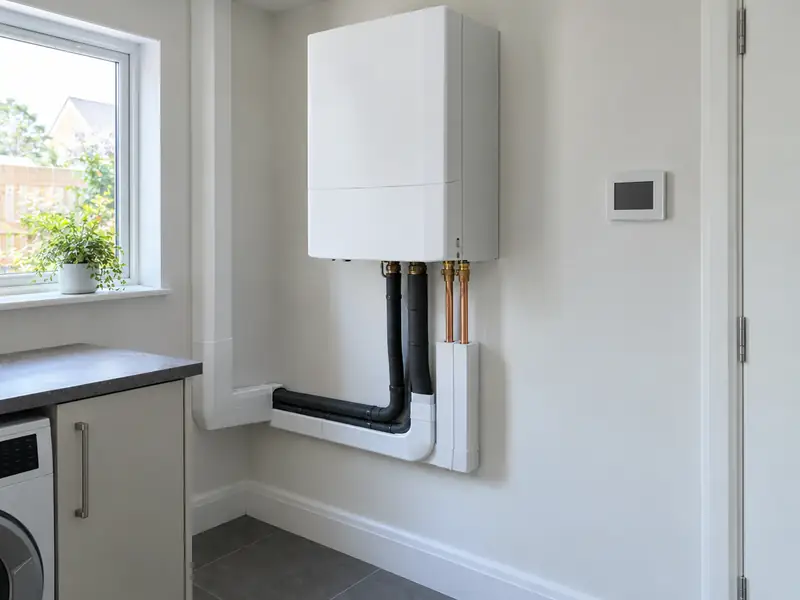
A split system heat pump is an air-to-water heat pump in two parts: an outdoor unit that collects heat from the air, and an indoor unit called a hydrobox where that heat is passed into the water for your heating and hot water. The two are connected by insulated refrigerant pipes rather than water pipes, so there is no water outside to freeze.
In Essex, a hydrobox often goes in an utility room or garage, with the cylinder alongside. In Essex homes where the clearest unit position is away from the plant cupboard, a split system allows a longer route indoors. Owners across Essex can compare split and monobloc designs side by side at a survey in Essex.
Who it suits
- Exposed or frost-prone sites where outdoor water pipes would be a risk
- Owners who would rather not use glycol or anti-freeze valves
- Small yards, roofs or balconies that suit a more compact outdoor unit
- Homes where the outdoor unit must sit some distance from the plant space
Grants and rules for heat pumps in England
Homes in Essex can use the Boiler Upgrade Scheme, which takes £7,500 off the cost of an air source heat pump when it replaces fossil-fuel or electric heating. Replacing oil or LPG heating qualifies for £9,000 for installations from 21 July 2026 to 31 March 2027, and air-to-air systems for £2,500. The MCS-certified installer named in your quote applies for the grant and deducts it from the price.
There is no VAT on installing a heat pump anywhere in the UK until 31 March 2027. In England most houses can have an air source heat pump under permitted development, provided the unit meets the MCS noise and siting standards; the old 1 m boundary limit was removed on 29 May 2025. We flag listed buildings, flats and sensitive conservation-area positions at survey.
Split system heat pumps prices in Essex
The ranges below are typical installed prices for homes in Essex, including VAT. A survey sets the exact figure, because two similar-looking houses in Essex can need quite different radiators and pipework.
| Home | Typical size | Installed guide price | After £7,500 grant |
|---|---|---|---|
| 1–2 bedroom flat or small terrace | 4–5 kW | £9,800–£12,900 | £2,300–£5,400 |
| 2–3 bedroom terrace or semi | 5–7 kW | £10,800–£13,900 | £3,300–£6,400 |
| 3 bedroom semi or small detached | 6–9 kW | £12,350–£15,950 | £4,850–£8,450 |
| 4 bedroom detached | 8–12 kW | £14,400–£18,550 | £6,900–£11,050 |
| 5+ bedroom or larger older house | 11–16 kW | £17,000–£23,200 | £9,500–£15,700 |
Installed, inc VAT: unit, cylinder, controls, minor pipework and commissioning.
Towns we cover in Essex
We cover 22 towns in Essex for split system heat pumps. Each links to local guide prices and the grant position for England.
| Town | Postcode district | Nearest town | Midwinter daylight |
|---|---|---|---|
| Southend-on-Sea | SS1 | Rayleigh | 7 h 49 min |
| Basildon | SS16 | Stanford-le-Hope | 7 h 49 min |
| Colchester | CO1 | Coggeshall | 7 h 46 min |
| Chelmsford | CM1 | Billericay | 7 h 47 min |
| Harlow | CM20 | Hoddesdon | 7 h 47 min |
| Braintree | CM7 | Coggeshall | 7 h 46 min |
| Clacton-on-Sea | CO15 | Harwich | 7 h 47 min |
| South Benfleet | SS7 | Canvey Island | 7 h 49 min |
| Canvey Island | SS8 | South Benfleet | 7 h 49 min |
| Billericay | CM12 | Basildon | 7 h 48 min |
| Rayleigh | SS6 | South Benfleet | 7 h 49 min |
| Stanford-le-Hope | SS17 | Basildon | 7 h 49 min |
| Wickford | SS12 | Rayleigh | 7 h 48 min |
| Witham | CM8 | Maldon | 7 h 46 min |
| Maldon | CM9 | Witham | 7 h 47 min |
| Harwich | CO12 | Felixstowe | 7 h 45 min |
| Saffron Walden | CB10 | Great Dunmow | 7 h 44 min |
| Burnham-on-Crouch | CM0 | Southend-on-Sea | 7 h 48 min |
| Coggeshall | CM8 | Witham | 7 h 46 min |
| Great Dunmow | CM6 | Braintree | 7 h 46 min |
| Halstead | CO9 | Coggeshall | 7 h 45 min |
| Loughton | IG10 | Chingford | 7 h 48 min |
Split system heat pumps questions
Is a split system more efficient than a monobloc?
Not inherently. Efficiency depends far more on design, meaning correct sizing, low flow temperatures and good controls, than on whether the unit is split or monobloc. A split system can avoid the heat loss and glycol of a long outdoor water run, which helps in certain layouts. The survey estimates seasonal efficiency for the specific units proposed, so you can compare like for like.
How far apart can the outdoor unit and hydrobox be?
It depends on the model: each manufacturer sets a maximum refrigerant pipe length and height difference, and longer runs may need extra refrigerant. In practice a split system allows more flexibility than a monobloc's water pipes, so the outdoor unit can often sit on the far side of a house, on a flat roof or round a corner. The survey measures the actual route.
How big is a hydrobox?
A hydrobox is typically about the size of a wall-mounted boiler, though sizes vary by make and model. It needs wall space near the cylinder with room around it for servicing and pipe connections. Some manufacturers combine the hydrobox and cylinder in a single floor-standing unit similar in size to a tall fridge-freezer, which can suit a utility room or garage.
Can a split system replace my combi boiler?
Yes, but like any air-to-water heat pump it needs a hot water cylinder, because it does not heat water instantly. The hydrobox can sometimes go where the combi was, with the cylinder in a cupboard, utility room or garage. Integrated units combining both are useful where one larger space is available. The survey checks what fits before the design is finalised.