
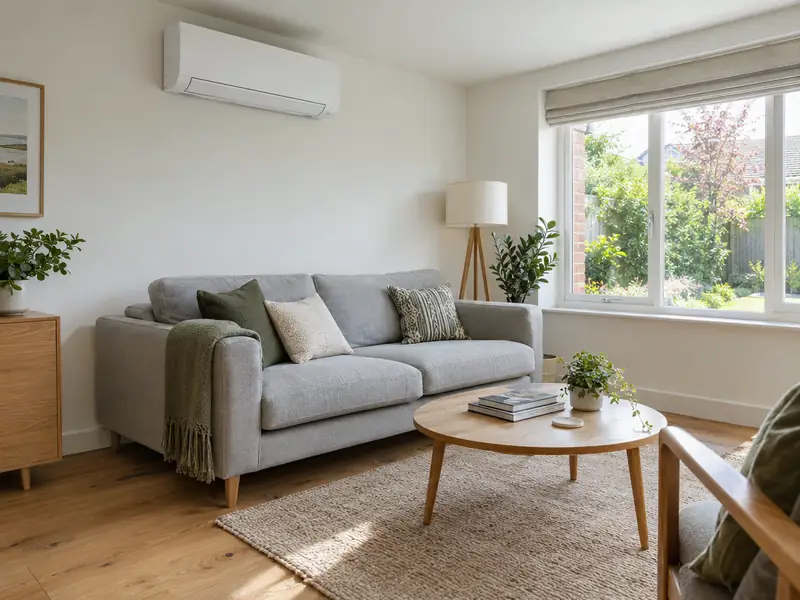
An air-to-air heat pump takes heat from the outside air and delivers it straight into rooms as warm air through indoor units, usually mounted high on a wall. The same system can run in reverse to cool rooms in summer. Unlike an air-to-water heat pump, it does not use radiators or underfloor heating and does not heat a hot water cylinder.
Installers in Lanarkshire plan condensate drains and pipe covers so indoor and outdoor runs stay neat. Top-floor rooms in Lanarkshire that overheat in summer gain from the cooling an air-to-air system provides. A survey in Lanarkshire covers indoor unit positions, pipe routes and hot water for homes across Lanarkshire.
Who it suits
- Homes where fitting radiators and pipework would be very disruptive
- Extensions, conservatories and garden rooms
- Rooms that get too hot in summer as well as cold in winter
- Flats and apartments with storage or panel heaters
Grants and rules for heat pumps in Scotland
In Scotland, heat pump funding comes through Home Energy Scotland rather than the Boiler Upgrade Scheme: a grant of up to £7,500 (up to £1,500 extra for eligible rural and island homes) and an optional interest-free loan of up to £7,500. For a home in Lanarkshire, apply and receive the written offer before the installation date is fixed.
Installing heat pumps is zero-rated for VAT across the UK until 31 March 2027. Scotland has its own permitted development rules for air source heat pumps and its own building standards, so we confirm what applies to your property at survey.
Air-to-air heat pumps prices in Lanarkshire
These are guide prices for Lanarkshire, installed and including VAT. Your final price is fixed in a written quote after the survey and depends on the heat loss of the house, the radiators that need changing and where the unit goes.
| System | Installed guide price |
|---|---|
| Air-to-air heat pump, 1–2 rooms | £2,400–£5,000 |
| Air-to-air heat pump, multi-room 3–4 bedroom home | £4,000–£8,000 |
Installed, inc VAT. Air-to-air systems heat (and can cool) rooms but do not provide hot water.
Towns we cover in Lanarkshire
We cover 13 towns in Lanarkshire for air-to-air heat pumps. Each links to local guide prices and the grant position for Scotland.
| Town | Postcode district | Nearest town | Midwinter daylight |
|---|---|---|---|
| East Kilbride | G74 | Cambuslang | 7 h 00 min |
| Hamilton | ML3 | Motherwell | 7 h 00 min |
| Cumbernauld | G67 | Airdrie | 6 h 57 min |
| Coatbridge | ML5 | Airdrie | 6 h 59 min |
| Airdrie | ML6 | Coatbridge | 6 h 59 min |
| Motherwell | ML1 | Bellshill | 7 h 00 min |
| Rutherglen | G73 | Cambuslang | 6 h 59 min |
| Cambuslang | G73 | Rutherglen | 6 h 59 min |
| Wishaw | ML2 | Motherwell | 7 h 00 min |
| Bellshill | ML4 | Motherwell | 6 h 59 min |
| Carluke | ML8 | Wishaw | 7 h 00 min |
| Lanark | ML11 | Carluke | 7 h 01 min |
| Strathaven | ML10 | Hamilton | 7 h 01 min |
Air-to-air heat pumps questions
Can an air-to-air heat pump heat my water?
No. An air-to-air heat pump heats and cools the air in rooms but does not produce hot water. You need a separate source, such as an existing immersion cylinder, a hot water heat pump or an electric water heater. If you want one system for heating and hot water, an air-to-water heat pump with a cylinder is the alternative.
How do I look after an air-to-air system?
Clean the indoor unit filters regularly, typically every few weeks during heavy use and following the manufacturer's guidance, and keep the outdoor unit clear of leaves and snow. Annual servicing is recommended and is often a condition of the manufacturer's warranty. Any work on the refrigerant circuit must be done by an F-gas certified engineer.
Are air-to-air heat pumps suitable for flats?
Often, yes. They need no radiators, pipework or cylinder, so they suit flats heated by storage or panel heaters. You need a position for the outdoor unit, such as a balcony, wall bracket or ground-floor yard, and leaseholders normally need the freeholder's or management company's consent. Planning rules for flats differ by nation, so we check what applies at survey.
How much sound do the indoor units make?
Indoor units are designed to run quietly, with a fan you will hear most when heating or cooling at full output. Lower fan settings and night modes reduce sound in bedrooms. Siting matters for the outdoor unit too: it needs airflow and a position that passes the MCS noise assessment. Ask to see the sound levels of the proposed units at survey.