
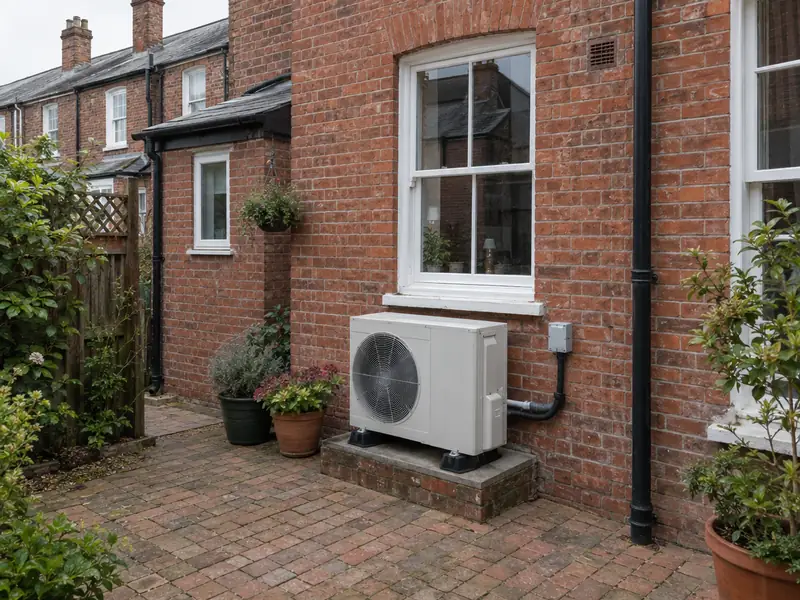
An air source heat pump makes a steady, low hum from its fan and compressor, and in a well-chosen position the sound is usually noticeable only close to the unit or when everything else is quiet. Units are designed to run quietly, but how loud one sounds in practice depends far more on where it is placed than on the model alone.
This guide explains how heat pump sound is measured, what the MCS noise assessment checks, the siting rules of thumb installers work to and how to keep neighbours on side. The exact position for your unit is agreed at survey, once the installer has seen your home, outside space and boundaries.
What does an air source heat pump sound like?
A running heat pump sounds like a low, even fan noise with a faint compressor hum, similar in character to the outdoor part of an air conditioning system.
The level changes with demand. On a mild day the unit runs slowly and quietly; on a very cold day it works harder and the fan speeds up. Most modern units vary their speed rather than switching hard on and off, which keeps the sound steadier and less noticeable.
Every so often in cold, damp weather the unit runs a defrost cycle to clear ice from its coil. You may hear a short change in sound, a click from a valve or a brief hiss, and see a little vapour rising from the unit. This is normal and usually lasts a few minutes.
Indoors, you should not normally notice the outdoor unit at all. Any sound you do hear inside is more likely to come from water moving through pipework or radiators, which an installer can usually reduce by adjusting pump speed or balancing the system.
What is the difference between sound power and sound pressure?
Sound power is the total sound energy a heat pump gives off, a fixed property of the machine; sound pressure is the level you actually hear at a particular spot, which depends on distance and surroundings.
Manufacturers publish a sound power level for each model in decibels, written dB(A), measured under standard test conditions. It is the fairest way to compare one unit with another, but it is not the number you will hear at your window. Sound pressure falls as you move away from the unit and rises when hard surfaces reflect sound back towards you.
Decibels work on a logarithmic scale, so small changes in the number mean real changes in what you hear. As a general guide:
- An increase of about 3 dB doubles the sound energy, though most people only just notice the difference
- An increase of about 10 dB sounds roughly twice as loud
- Doubling your distance from a unit in open space lowers the sound pressure level by about 6 dB
- Each hard surface close to the unit, such as a wall, reflects sound and adds around 3 dB
That last point is why position matters so much. The same unit can sound noticeably louder tucked into a corner between two walls than standing against a single flat wall a few metres further from the nearest window.
What is the MCS noise assessment?
The MCS noise assessment is a calculation, set out in the MCS planning standards, that predicts the sound level from a heat pump at the nearest window of a neighbour's habitable room and checks it against the limit in the standard.
A habitable room means a bedroom, living room or similar space, not a bathroom or hallway. The installer uses the unit's published sound power level, the distance to that window, the number of reflecting surfaces around the unit and whether a solid barrier blocks the line of sight. If the result is too high, the unit is moved, turned or screened, or a different model is chosen, until it passes.
In England, permitted development lets most houses have an air source heat pump without a planning application, provided the installation meets the MCS planning standards, including this noise assessment. Since 29 May 2025, the rules in England allow up to two air source heat pumps on a house, each outdoor unit up to 1.5 m³, and the old rule requiring planning permission for a unit within 1 m of a boundary has been removed. The noise assessment still applies, so a unit near a boundary must still pass it.
In England, listed buildings need listed building consent, and flats, some conservation-area positions and units on a front elevation may need planning permission. Wales, Scotland and Northern Ireland each have their own permitted development rules for heat pumps, and we check what applies to your home at survey. The planning permission guide has more detail.
Where should an air source heat pump be placed?
The right spot for a heat pump is outside on a solid, level base, with free airflow around it, a short pipe run to the house, a way for condensate to drain and room for an engineer to work.
- Airflow. The unit draws air through its coil and blows colder air out of the front. It needs the clear space set out in the manufacturer's instructions, so it does not pull its own cold air back in.
- Away from bedroom windows. Keep the unit away from your own bedroom windows and, wherever possible, from your neighbours'. Night is when homes are quietest and a steady hum is easiest to notice.
- Not in an enclosed corner. Corners, narrow side passages, alcoves and spaces under low decks or balconies trap air and reflect sound, which makes the unit both less efficient and louder.
- Condensate drainage. A heat pump produces water, especially during defrost. It needs a soakaway, gravel bed or drain, and should not drip onto a path or drive where it could freeze.
- Anti-vibration feet. Rubber feet or mounts stop vibration passing into the base or wall. Wall brackets on a wall shared with a bedroom are usually avoided for the same reason.
- Raised off the ground. Feet or a plinth lift the unit clear of standing water, drifting snow and leaves.
- Short pipe runs. The closer the unit is to where pipes enter the house, the less heat is lost on the way and the easier the pipework is to protect from frost.
- Access for servicing. An engineer needs to reach the front, sides and electrical panel safely, so the unit should not be boxed in or reachable only from a ladder.
Some refrigerants, including R290 (propane), come with extra clearances from doors, windows, drains and other openings, set by the manufacturer. Your installer factors these in alongside the noise assessment when proposing a position.
Can I screen a heat pump or build an enclosure around it?
You can screen a heat pump, but anything built around it must leave enough space for airflow and servicing, or the unit will run less efficiently and may sound louder.
Open slatted screens, low planting and acoustic fencing placed a sensible distance from the unit are common choices. A solid barrier that breaks the line of sight between the unit and a neighbour's window can lower the level they hear, and the MCS noise assessment can take this into account.
Avoid fully enclosing the unit, roofing it over tightly or packing planters against the fan. Check with your installer before building anything, because some changes could affect the manufacturer's warranty or the noise calculation the installation was based on.
How should I approach neighbours about a heat pump?
Talking to your neighbours before installation is the simplest way to avoid problems, even where no planning application is needed.
Let them know roughly where the unit will go and that its position has been chosen with noise in mind. If they have a bedroom window near the boundary, it can help to explain that the MCS assessment calculates the sound level at their window, not just at yours.
Once the system is running, a unit that suddenly becomes louder, rattles or buzzes usually needs attention rather than putting up with. Loose panels, a worn fan bearing or a unit that has settled off level are all things an engineer can check, and an annual service is a good time to raise any noise concerns. See heat pump servicing.
Questions
Is an air source heat pump louder than a gas boiler?
Outside, a heat pump unit makes more sound than a boiler flue, because its fan and compressor are outdoors. Inside the house, a well-installed heat pump system is usually quieter than a boiler for the same reason. How loud the outdoor unit sounds depends mainly on its position, the hard surfaces around it and how hard it is working on the day.
Does a heat pump run all night?
Often, yes, in cold weather. Heating is most efficient when the system runs steadily at a low flow temperature, so a heat pump may keep ticking over through the night, usually at a lower speed because demand is lower. This is one reason installers keep units away from bedroom windows and why the MCS noise assessment matters.
Can a heat pump go at the front of my house?
Sometimes. In England, a unit on a front elevation may need planning permission in some cases, for example in a conservation area, and the installation must still meet the MCS standards. Wales, Scotland and Northern Ireland have their own rules. We check what applies at survey and suggest the position that works with the fewest issues.
Is it normal for a heat pump to give off steam?
Yes. You may see a little vapour rising from the unit during a defrost cycle in cold, damp weather. It is water vapour from melting frost, not smoke or a sign of a fault, and it normally clears within a few minutes. If the unit defrosts constantly, or thick ice builds up and does not clear, ask for it to be checked.
Sources
- Heat pumps – Planning Portal
- MCS (Microgeneration Certification Scheme)
- Air source heat pumps – Energy Saving Trust
Scheme figures and price cap rates checked October 2026.