
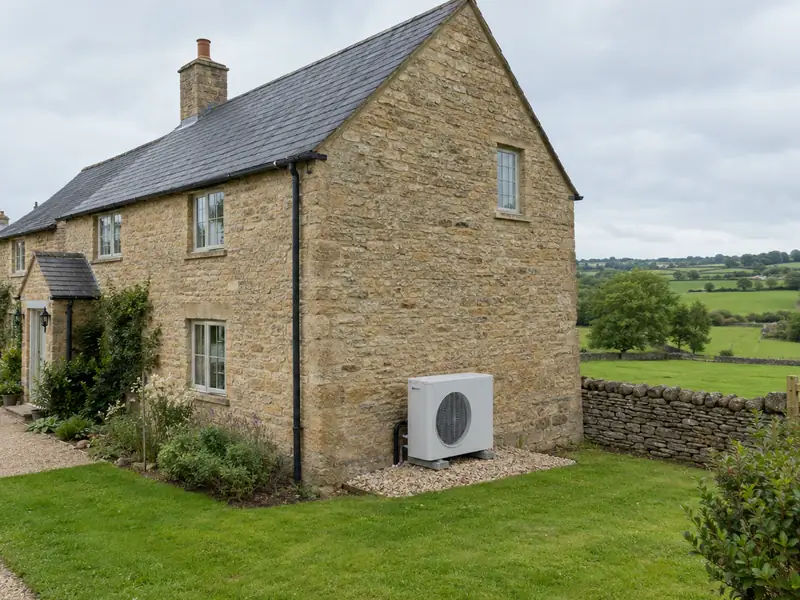
A heat pump can work well in an older home, including Victorian and Edwardian houses, solid-wall terraces and stone cottages, as long as it is sized from a proper heat loss calculation and the radiators suit a low flow temperature. Older homes usually lose heat faster than modern ones, so the unit may be larger and more radiators may need upgrading, but age alone does not rule a heat pump out.
This guide covers whether to insulate first, how to deal with draughts, when a high-temperature heat pump makes sense, the extra care needed for listed buildings, and what to expect from comfort and running costs.
Do heat pumps work in old houses?
Yes. A heat pump works in any home where it can supply enough heat, and that depends on the design rather than the age of the building.
Older homes tend to have solid walls with no cavity, single-glazed or older windows, suspended timber floors and open chimneys. All of these raise heat loss, which the room-by-room calculation captures. A higher heat loss means a larger unit, which for a large period house can be in the 11–16 kW band, and larger radiators in some rooms.
Thick masonry walls also store heat. Heat pumps run steadily for long periods, which suits heavy buildings that take a long time to warm up and cool down.
Should I insulate before getting a heat pump?
You do not need to insulate everything before fitting a heat pump, but the low-cost, low-risk improvements are usually worth doing first because they reduce the size of unit and radiators needed.
- Loft insulation, which is usually simple and inexpensive
- Draught-proofing doors, windows, floorboards and loft hatches
- Closing off unused chimneys with a removable cap or balloon, while keeping some ventilation
- Insulating suspended timber floors where there is access from below
- Secondary glazing, which can suit period windows that need to be kept
Solid wall insulation is a bigger decision. Internal or external wall insulation can reduce heat loss considerably, but it is disruptive and costly, and in older buildings it needs specialist advice to avoid trapping moisture in walls built to breathe. A heat pump can still be designed for a home without it. The heat loss calculation can model the home as it is and with improvements, so you can see what each one changes.
How much do draughts matter for a heat pump?
Draughts matter a great deal in older homes, because air leaking through gaps can account for a large share of heat loss and makes rooms feel colder at the same temperature.
Sash windows, gaps between floorboards, unused chimneys, loft hatches and old letterboxes all let warm air escape. Heat pumps deliver heat gently, so a draughty room struggles more than it would with hot radiators. Draught-proofing is usually quick and inexpensive, and it can make a real difference to comfort.
Older buildings still need ventilation to manage moisture, so the aim is to stop uncontrolled draughts, not to seal the house. Keep extractor fans, trickle vents and any air bricks that serve a purpose.
Is a high-temperature heat pump better for an older home?
A high-temperature heat pump can supply hotter water than a standard model, closer to what a boiler provides, which can mean fewer radiator changes in an older home, at the cost of lower efficiency when it runs hot.
High-temperature units suit homes where radiators cannot easily be enlarged, such as period rooms with original features, or where pipework upgrades would be very disruptive. The extra over a standard unit is a typical £1,500–£3,000, as a guide price installed and including VAT.
Running at higher temperatures lowers the SCOP, so running costs are usually higher than a standard heat pump would achieve in a home that could run cooler. The efficient approach is still to design for the lowest flow temperature the home allows. A hybrid system is another option, though hybrids are not eligible for the Boiler Upgrade Scheme in England and Wales. See our hybrid vs full heat pump guide.
Can I have a heat pump on a listed building or in a conservation area?
You can often fit a heat pump to a listed building, but you need listed building consent first, and some positions in conservation areas may need planning permission.
Consent usually depends on where the outdoor unit goes and how pipes and cables enter the building. A rear or side position screened from view, routes that avoid historic fabric, and radiators that respect the character of the rooms all help. The council's conservation officer can advise early on.
Planning rules differ by nation. In England, permitted development has allowed more flexible siting since 29 May 2025, but that does not remove the need for listed building consent. Wales, Scotland and Northern Ireland have their own rules, and we check what applies at survey. Our planning permission guide has more detail.
What should I realistically expect from a heat pump in an older home?
Expect a well-designed heat pump to keep an older home comfortably warm with steady, gentle heat, but often at a lower seasonal efficiency than the same system would achieve in a modern, well-insulated house.
- A larger unit and more radiator upgrades than a newer home of the same size
- A design flow temperature towards the upper end of the usual 35–50°C range, unless radiators are upgraded generously
- Heating that runs for long periods rather than in quick bursts, with warm rather than hot radiators
- Space for a hot water cylinder, as there is no combi-style equivalent
- Running costs that depend heavily on draught-proofing, flow temperature and tariff
Grants can help with the cost. In England and Wales the Boiler Upgrade Scheme gives £7,500, and since 28 April 2026 no valid EPC is needed to apply. In Scotland, Home Energy Scotland offers a grant and an optional interest-free loan, with extra support for eligible rural and island homes. Northern Ireland has no dedicated heat pump grant for homeowners at present.
The survey is the place to test all of this. The heat loss calculation, the radiator check and the estimated SCOP give you a realistic picture before you commit to anything.
Questions
Will a heat pump work in a house with solid walls?
Yes, if it is designed for the home's actual heat loss. Solid walls lose more heat than insulated cavity walls, so the heat pump may need to be larger and some radiators upgraded. The room-by-room heat loss calculation accounts for the wall construction, and solid wall insulation is not essential for a heat pump to work.
Do I need to replace my sash windows?
Not usually. Draught-proofing sash windows and adding secondary glazing can reduce heat loss while keeping the original windows, which matters in period and listed homes. The heat loss calculation uses the windows as they are, so any improvement you make lowers the heat the system has to supply.
Is a high-temperature heat pump the answer for an old house?
Sometimes. A high-temperature heat pump can heat older radiators closer to boiler temperatures, which helps where rooms cannot take larger radiators. It runs less efficiently at those temperatures, so a standard unit with selected radiator upgrades may cost less to run. The survey compares both so you can choose.
Can a heat pump go on a listed cottage?
Often, yes, with listed building consent, which you need before work starts. A discreet outdoor position, careful routes for pipes and cables, and radiators that suit the rooms all help an application. Rules differ in England, Wales, Scotland and Northern Ireland, so we check what applies at the free survey for installation enquiries.
Sources
- Air source heat pumps – Energy Saving Trust
- Heat pumps – Planning Portal
- MCS (Microgeneration Certification Scheme)
- Home Energy Scotland
Scheme figures and price cap rates checked October 2026.