
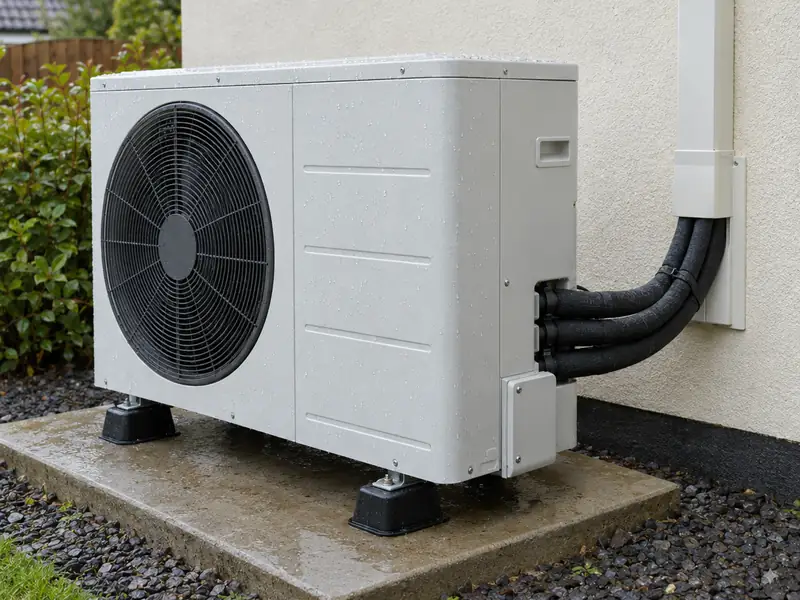
An air source heat pump is an electric heating system that takes heat from the outdoor air and moves it into your home's radiators, underfloor heating and hot water cylinder. Because it moves heat rather than making it by burning fuel, a well-designed system typically delivers about 3–4 kWh of heat for every kWh of electricity it uses over a year.
This guide explains the refrigerant cycle in plain English, what efficiency figures such as COP and SCOP mean, why flow temperature matters so much, and how a heat pump copes with cold, damp weather.
How does a heat pump get heat from cold air?
A heat pump extracts heat from outdoor air using a refrigerant, a fluid that boils at a very low temperature, so even air that feels cold to us still contains heat it can use.
The process works like a fridge in reverse. A fridge pumps heat out of its cabinet into your kitchen; a heat pump pumps heat out of the outdoor air and into your heating water. It runs in a continuous loop with four stages:
- Evaporate: a fan draws outdoor air across a coil, and the cold refrigerant inside absorbs heat from it and turns into a gas
- Compress: an electric compressor squeezes the gas, which raises its temperature sharply
- Condense: the hot gas passes through a heat exchanger, giving its heat to the water in your heating system, and turns back into a liquid
- Expand: the liquid passes through an expansion valve, which drops its pressure and temperature so the cycle can start again
Electricity drives the compressor, fan and pumps. Most of the heat delivered comes from the air itself, which is why the heat output is several times the electrical input. Common refrigerants in current units are R32 and R290, which is propane.
What is the difference between COP and SCOP?
COP (coefficient of performance) is a heat pump's efficiency under one set of conditions, while SCOP (seasonal coefficient of performance) is its average efficiency across a whole heating season.
A COP of 4 means 4 kWh of heat for each 1 kWh of electricity at that moment. COP changes all the time: it is higher on a mild day than a freezing one, and higher when the water being heated is cooler. Manufacturers quote COP at standard test conditions, so a single COP figure says little about running costs in your home.
| COP | SCOP | |
|---|---|---|
| What it measures | Efficiency at one moment and set of conditions | Average efficiency over a heating season |
| What changes it | Outdoor temperature and flow temperature | Climate, system design, flow temperature and controls |
| Useful for | Comparing units at the same test point | Estimating running costs for your home |
SCOP is the more useful number. A SCOP of about 3–4 is common in well-designed systems. Your home's heat loss and design flow temperature determine the SCOP your installer estimates, and that estimate should appear in your quote.
What is flow temperature and why does it matter?
Flow temperature is the temperature of the water a heat pump sends to your radiators or underfloor heating, and the lower it can be while keeping rooms warm, the more efficiently the heat pump runs.
A heat pump works hardest when it has to lift heat from cold air to very hot water. Most systems are designed to run at around 35–50°C, lower than many gas boilers are set to. Underfloor heating suits heat pumps well because its large surface gives off plenty of heat at low water temperatures. Radiators work too, but some may need to be larger.
Weather compensation controls adjust the flow temperature to the weather outside: cooler water on mild days, warmer water on cold ones. This keeps the system at the lowest temperature that does the job, which is one of the simplest ways to protect efficiency.
What happens when a heat pump defrosts?
Defrosting is a short, automatic cycle in which the heat pump melts ice that has built up on its outdoor coil, and it is a normal part of running in cold, damp weather.
When the air is close to freezing and humid, moisture can freeze on the coil and block the airflow. The unit senses this and briefly warms the coil, usually by reversing its refrigerant cycle. You may see a little vapour rising from the unit and water dripping beneath it; both are normal.
Because meltwater drains from the unit, the installer plans a route for it so that it does not pool on a path or freeze into a slip hazard. Heat output pauses briefly during a defrost, and a well-designed system allows for this so rooms stay comfortable.
Do air source heat pumps work in cold weather?
Yes. Air source heat pumps are designed to keep working well below freezing, and systems in the UK are sized to heat the home on a cold winter's day, not just an average one.
Output and efficiency fall as the outdoor air gets colder, because there is less heat to collect and a bigger temperature lift to the heating water. That is expected and allowed for in the design. The heat loss calculation uses a design outdoor temperature for your location, a cold-day condition the system must cope with, so the unit is sized to keep you warm on those days.
Heat pumps also heat differently from boilers. They usually run for longer at a gentle output rather than in short, hot bursts, so radiators feel warm rather than hot. Steady heating keeps rooms at an even temperature through the day.
What is the difference between monobloc and split heat pumps?
A monobloc heat pump keeps all of its refrigerant inside the outdoor unit and connects to your home with water pipes, while a split system runs refrigerant lines to an indoor unit.
Monobloc units are simpler to install because only water pipework is connected on site, and the pipes outside are insulated and protected against frost. Split systems can suit homes that need a smaller outdoor unit or a longer distance between the unit and the cylinder, and the refrigerant work must be done by an F-gas certified engineer. Our guide to monobloc vs split heat pumps compares them in detail.
Why does heat pump design matter so much?
A heat pump's running costs and comfort depend more on how the whole system is designed than on the outdoor unit itself.
- Sizing from a room-by-room heat loss calculation, so the unit matches the home
- Radiators or underfloor heating that deliver enough heat at a low flow temperature
- Pipework large enough for the water flow a heat pump needs
- A hot water cylinder sized for your household
- Controls set up with weather compensation and sensible schedules
- An outdoor position with good airflow, a drainage route for defrost water and a noise check
With these right, a heat pump typically runs at a good seasonal efficiency for an expected life of 15–20 years, with annual servicing. With them wrong, the same unit can end up running at a higher flow temperature and costing more to run.
Questions
Does a heat pump work like an air conditioner?
In principle, yes. Both use a refrigerant cycle to move heat. An air conditioner moves heat out of a room; an air-to-water heat pump moves heat from the outdoor air into the water in your heating system and hot water cylinder. Air-to-air heat pumps work much like reversible air conditioning, warming rooms directly with blown air.
What is a good SCOP for a heat pump?
A SCOP of about 3–4 is common in well-designed systems, meaning roughly 3–4 kWh of heat for each kWh of electricity over a year. The figure for your home depends on its heat loss, the design flow temperature, the radiators or underfloor heating and the controls, so ask for the estimated SCOP in your quote.
Is the vapour from my heat pump a problem?
Usually not. A little vapour rising from the outdoor unit in cold, damp weather is normally the defrost cycle melting ice from the coil, and water dripping beneath the unit is meltwater. If the unit stays covered in thick ice that does not clear, or shows a fault code, ask an engineer to check it.
Can a heat pump heat my hot water?
Yes. An air-to-water heat pump heats a hot water cylinder as well as your radiators or underfloor heating. There is no combi-style equivalent, so a cylinder sized for your household is needed. Systems are usually set to run a periodic higher-temperature cycle to protect against legionella, which is set up at commissioning.
Sources
Scheme figures and price cap rates checked October 2026.