
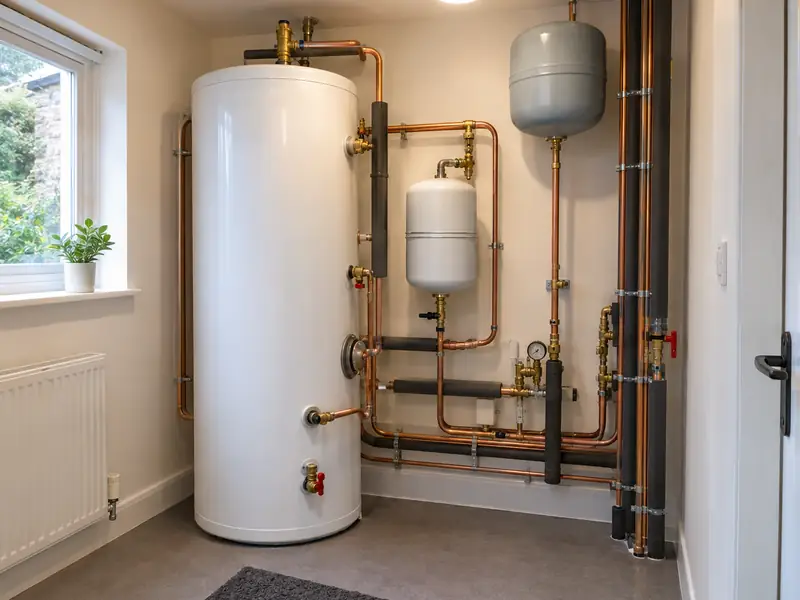
A hybrid heat pump is an air source heat pump that works alongside a boiler, usually your existing gas boiler, with a controller deciding which one heats the home at any time. A full heat pump system replaces the boiler entirely and meets all of your heating and hot water needs on its own.
Hybrids can suit some homes as a lower-disruption step, but they are not eligible for the Boiler Upgrade Scheme in England and Wales, and they keep you using fossil fuel for part of the year. This guide explains how hybrids work, when they might make sense, how the costs compare and what to think about for the long term.
How does a hybrid heat pump work?
A hybrid system pairs a heat pump with a boiler and uses a controller to switch between them, or run both, depending on outdoor temperature, demand and the settings you choose.
In milder weather, which covers much of the heating season, the heat pump does the work. In very cold spells, or when the house needs a quick boost, the boiler takes over or tops up. Some hybrids keep a combi boiler for hot water, so no cylinder is needed; others heat a cylinder with the heat pump.
The controller can usually be set to favour lower carbon or lower running cost. The balance it strikes depends on the relative prices of electricity and gas, which change over time.
When might a hybrid heat pump make sense?
A hybrid might make sense where a full system would mean major disruption now, the existing boiler is fairly new, or there is no room for a hot water cylinder.
- Your gas boiler is relatively new and you want to keep using it
- Your home has a high heat loss and you are not ready to change radiators or add insulation yet
- There is no practical space for a hot water cylinder and you want to keep a combi
- You accept that a hybrid will not get the Boiler Upgrade Scheme grant in England and Wales
- You plan to move to a full system later, in stages
A hybrid is usually a weaker fit where the boiler is old and due for replacement anyway, where you want to remove the gas supply altogether, or where the home could take a full system with only a few radiator changes. In those cases the extra appliance adds cost and upkeep without much benefit.
For many homes, a correctly designed full heat pump system works without any backup boiler. A survey and heat loss calculation shows which route suits yours.
How do hybrid and full heat pump costs compare?
A hybrid system has a guide price of £7,000–£11,000 installed including VAT, while a full air-to-water system for a three-bedroom home typically costs £12,000–£15,500 installed including VAT, before any grant.
| Option | Guide price, installed inc VAT | Boiler Upgrade Scheme (England and Wales) |
|---|---|---|
| Hybrid heat pump alongside an existing boiler | £7,000–£11,000 | Not eligible |
| Full system, 2–3 bedroom terrace or semi | £10,500–£13,500 | £7,500 grant; about £3,000–£6,000 after it |
| Full system, 3 bedroom semi or small detached | £12,000–£15,500 | £7,500 grant; about £4,500–£8,000 after it |
| Full system, 4 bedroom detached | £14,000–£18,000 | £7,500 grant; about £6,500–£10,500 after it |
Once the standard grant is deducted in England and Wales, a full system can cost a similar amount to a hybrid, or less, depending on the home. In Scotland, check with Home Energy Scotland what funding applies to your chosen system before you commit. In Northern Ireland there is no dedicated heat pump grant for homeowners at present.
Why is a hybrid not eligible for the Boiler Upgrade Scheme?
A hybrid is not eligible for the Boiler Upgrade Scheme because the scheme, which covers England and Wales, requires the heat pump to meet the home's full heating and hot water needs on its own.
The scheme is designed to replace fossil-fuel heating completely, so a system that keeps a gas or oil boiler for part of the load does not meet that condition. The scheme pays £7,500 towards an air source heat pump, or £9,000 when it replaces oil or LPG heating and is installed between 21 July 2026 and 31 March 2027, so the grant makes a real difference to the comparison.
The Boiler Upgrade Scheme does not cover Scotland or Northern Ireland. The Boiler Upgrade Scheme guide sets out the full eligibility rules.
How do running costs compare between hybrid and full systems?
Running costs for a hybrid depend on how much of the heat comes from each appliance, while a full system's costs depend on its seasonal efficiency, your flow temperature and your tariff.
Under the Ofgem price cap for October to December 2026 (Great Britain average, Direct Debit), a heat pump with a SCOP of 3.0 delivers heat for about 8.8p per kWh, about 7.5p at SCOP 3.5 and about 6.6p at SCOP 4.0. A 90% efficient gas boiler delivers heat for about 8.9p per kWh, or about 9.4p at 85% efficiency. The gap between them depends on the efficiency the heat pump actually achieves in your home, which is why flow temperature and design matter so much.
A full system also lets you remove the gas meter, which saves the gas standing charge of about £108 a year. With a hybrid you keep paying it, because the boiler still needs gas. These figures are averages; your costs depend on insulation, flow temperature and tariff.
What are the long-term considerations?
Over the long term, a hybrid means running and maintaining two heating appliances, while a full system leaves you with one.
- Maintenance. A hybrid needs a heat pump service and a boiler service, plus gas safety checks.
- Replacement. The boiler will still wear out, and you face the same decision again when it does.
- Standing charges. Keeping a gas supply means paying the gas standing charge every day.
- Carbon. A hybrid still burns fossil fuel in the coldest weather, when demand is highest.
- Upgrades. Radiator and insulation upgrades over time can let the heat pump take on more of the load, though a larger unit may be needed to go fully electric.
- Grants. The Boiler Upgrade Scheme in England and Wales has been extended to 2030, but grant amounts and rules can change.
See hybrid heat pumps and gas boiler to heat pump for more on each route.
Questions
Can I get a grant for a hybrid heat pump?
Not through the Boiler Upgrade Scheme in England and Wales, which excludes hybrid systems because the heat pump must meet all of the home's heating and hot water needs. In Scotland, check with Home Energy Scotland what support applies before committing. Northern Ireland has no dedicated heat pump grant for homeowners at present.
Does a hybrid need a hot water cylinder?
Not always. Some hybrids keep a combi boiler to provide hot water on demand, with the heat pump handling space heating, so no cylinder is needed. Others use the heat pump to heat a cylinder as well. A full heat pump system always needs a hot water cylinder, because there is no combi equivalent.
Can I convert a hybrid to a full heat pump later?
Sometimes. If the heat pump in the hybrid is large enough, and your radiators and insulation are upgraded, it may be able to take on the whole load with the boiler removed. In other cases a larger unit is needed. A room-by-room heat loss calculation at the start helps plan for this.
Is a hybrid cheaper to run than a full heat pump?
Not necessarily. A hybrid uses the boiler in the coldest weather, and you keep paying the gas standing charge. A well-designed full system running at a low flow temperature can cost less to run, but it depends on your home, your tariff and fuel prices at the time. Your survey gives an estimate for your home.
Sources
- Apply for the Boiler Upgrade Scheme – GOV.UK
- Boiler Upgrade Scheme – Ofgem
- Air source heat pumps – Energy Saving Trust
Scheme figures and price cap rates checked October 2026.