
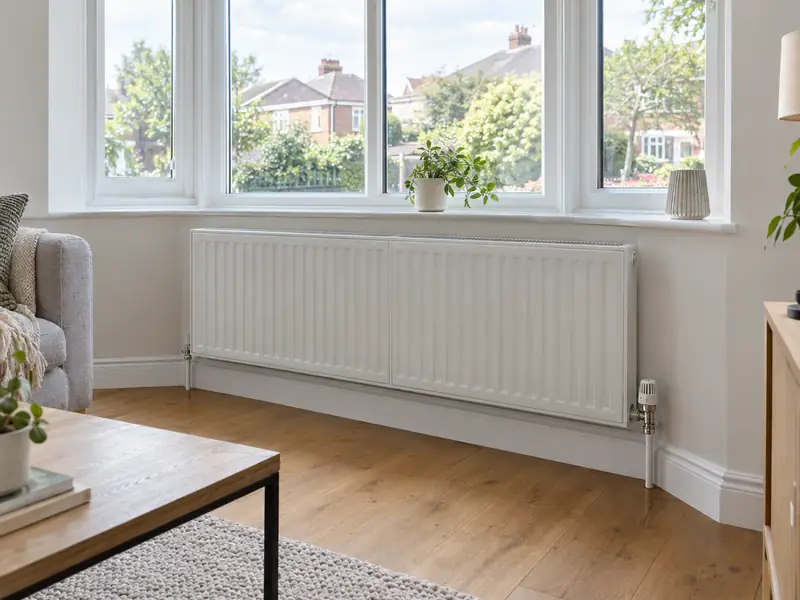
You usually need to replace some radiators, but not all of them, when you switch to a heat pump. Heat pumps run most efficiently at lower water temperatures than most boilers, so a radiator that heats its room well today may give out too little heat at heat pump temperatures.
The heat loss calculation at your survey shows exactly which rooms fall short. This guide explains why flow temperature changes the sums, which rooms usually need attention, the main radiator options, pipework, and typical guide costs.
Why do heat pumps need bigger radiators?
Heat pumps often need bigger radiators because they heat the water to a lower temperature, and a radiator's heat output falls as its water gets cooler.
Many gas boilers send water to the radiators at a high temperature. Heat pumps run most efficiently at around 35–50°C, and each step lower improves efficiency. At those temperatures a radiator gives out noticeably less heat, so to keep the room just as warm it needs more surface area.
Radiator outputs are usually published at a test condition called 'delta T 50', which assumes water much hotter than a heat pump normally supplies. An installer adjusts the published figure to the design flow temperature for your home, then compares it with each room's heat loss.
Delta T is the difference between the average temperature of the water in the radiator and the temperature of the room. At heat pump temperatures that difference is much smaller, so a radiator's real output can be a fraction of its published figure, depending on the flow temperature.
Which rooms usually need new radiators?
The rooms that need new radiators are those where the existing radiator cannot meet the room's heat loss at the design flow temperature, which is often only a few rooms in the house.
- Living rooms, which are designed warmer than bedrooms
- Rooms with large windows, bay windows or patio doors
- Extensions and rooms with several external walls
- Bathrooms, where a small towel rail may be the only heat source
- Rooms where the radiator was undersized to begin with
Bedrooms are often fine, because they are designed cooler and their radiators were frequently sized generously. The aim is a radiator in each room that can hold its design temperature, not a matching set throughout the house.
The whole system has to work together. A heat pump can only run at its design flow temperature if every room keeps up, so one undersized radiator in a room you use a lot can push the whole system to run hotter and less efficiently.
What types of radiator work with heat pumps?
Any standard wet radiator works with a heat pump; the question is whether it is large enough, and the main options add output without always adding width.
| Option | How it helps | Things to know |
|---|---|---|
| Double panel radiator | Two panels with fins between them give more output than a single panel of the same size | A common like-for-like upgrade from a single panel |
| Triple panel radiator | Three panels and fins give more output again from the same wall space | Deeper, so it sits further out from the wall |
| Larger or taller radiator | More surface area gives more heat at low water temperatures | Needs the wall space |
| Fan-assisted radiator | Small fans push air across the heat exchanger, giving high output from a compact unit at low temperatures | Needs an electrical supply and makes a little fan noise |
| Underfloor heating | The whole floor gives out gentle heat at low water temperatures | A bigger job, usually during a renovation |
Fan-assisted radiators suit rooms where wall space is tight. Underfloor heating suits heat pumps well and is often fitted in a kitchen or extension, with radiators elsewhere.
Will my pipework need changing too?
Pipework sometimes needs changing, because a heat pump circulates more water through the system than a boiler does, and narrow pipes can restrict that flow.
Heat pumps heat the water by a smaller temperature step than boilers, so they move a larger volume of water to deliver the same heat. Homes with microbore pipes, the narrow 8 mm or 10 mm pipes often fitted in the 1970s and 1980s, may not carry enough flow to larger radiators.
The survey checks pipe sizes and routes. Sometimes only the main runs need upgrading; in other homes, new pipework to several radiators makes more sense. A pipework upgrade is a typical £1,500–£3,500 as a guide price, installed and including VAT.
How much do heat pump radiators cost?
Replacing a radiator for a heat pump typically costs £250–£450 per radiator, supplied and fitted, as a guide price including VAT.
| Work | Guide price, installed inc VAT |
|---|---|
| One replacement radiator, sized for a heat pump | £250–£450 |
| Upgrade of about 10 radiators | £2,000–£5,000 |
| Pipework upgrade, such as microbore to larger bore | £1,500–£3,500 |
| Wet underfloor heating, one room | £1,500–£3,500 |
Radiator work is usually priced as part of the full installation, so it appears in your quote alongside the heat pump and cylinder. Across the UK the installation of heat pumps is zero-rated for VAT until 31 March 2027, and your quote shows how VAT applies to each part of the job.
Any grant is set against the whole installation rather than the radiators alone: in England and Wales through the Boiler Upgrade Scheme, and in Scotland through Home Energy Scotland, subject to the terms of your written funding offer. Northern Ireland has no dedicated heat pump grant for homeowners at present.
Can I keep my existing radiators?
You can often keep many of your existing radiators, especially if they are already generously sized, the home is well insulated, or the design uses a slightly higher flow temperature.
There is a trade-off. A system designed for a lower flow temperature usually needs more radiator upgrades but runs more efficiently for its whole life. A higher design flow temperature means fewer upgrades but a lower SCOP. Good design finds the balance for your home and budget, and your quote should state the flow temperature it is based on.
Improving a room's insulation, for example with loft insulation or draught-proofing, can lower its heat loss enough for the existing radiator to cope. See our guide to heat pump sizing and heat loss for how each room is calculated.
Questions
Do I need to replace every radiator for a heat pump?
Rarely. Most homes need a few radiators upgraded, not a full set. The heat loss calculation compares each room's heat loss with its radiator's output at the design flow temperature, and only rooms that fall short need a larger radiator or another emitter. Bedrooms are often fine; living rooms and rooms with large windows more often need attention.
Will heat pump radiators feel as hot as before?
No. Radiators on a heat pump feel warm rather than hot, because the water is cooler. The room still reaches the same temperature, because the radiator is larger and the heat pump runs for longer at a steady output. This gentler heat is normal and is how the system stays efficient.
Can I use fan-assisted radiators with a heat pump?
Yes. Fan-assisted radiators use small fans to push air across a heat exchanger, so they give a high output at low water temperatures from a compact unit. They suit rooms with little wall space. They need an electrical supply and make a little fan noise, so they are often chosen for living areas rather than bedrooms.
Do microbore pipes stop me having a heat pump?
No, but microbore pipes can restrict the higher water flow a heat pump needs, especially to larger radiators. The survey checks pipe sizes and routes. Sometimes upgrading only the main runs is enough; in other homes new pipework to several radiators is needed. A pipework upgrade is a typical £1,500–£3,500 guide price, installed and including VAT.
Sources
Scheme figures and price cap rates checked October 2026.