
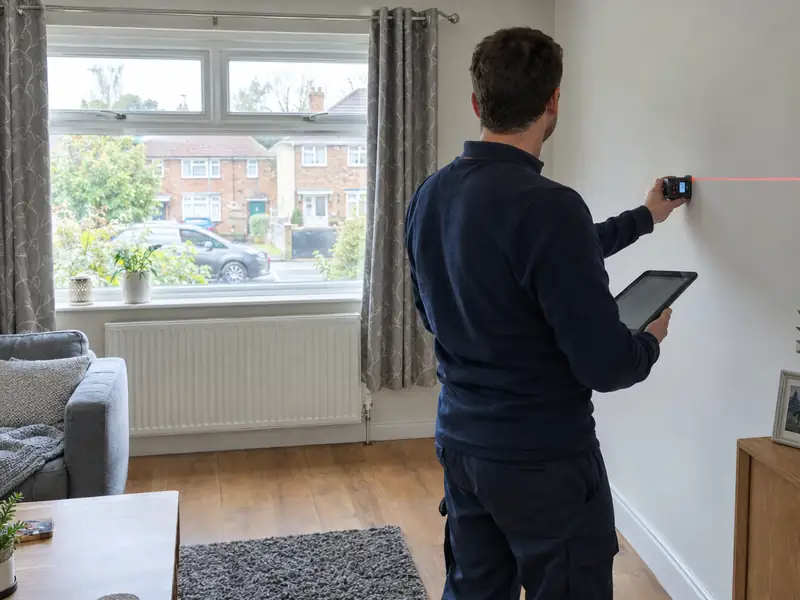
Getting the size right matters. An undersized heat pump struggles in cold weather, while an oversized one costs more to buy and can switch on and off frequently, which wastes energy and wears components. Sizing from a rule of thumb, or simply matching the old boiler's output, is a common cause of poorly performing systems. A measured, room-by-room design avoids both problems and shows the reasoning behind every figure.
Homeowners in Argyll and Bute thinking about insulation work can use the survey to see how it would change their heat pump size. A surveyor visits your home to measure each room, window and wall before any heat pump is sized. The survey in Argyll and Bute includes a check of where the outdoor unit could sit and how its sound would reach neighbours.
Who it suits
- Self-builders and architects who need emitter and system sizes early
- Landlords comparing properties before deciding where to switch first
- Homes with an existing heat pump that seems undersized or expensive to run
- Anyone getting a heat pump quote, as the first step
Grants and rules for heat pumps in Scotland
The Boiler Upgrade Scheme does not apply in Scotland. Instead, homeowners in Argyll and Bute can apply to Home Energy Scotland for a grant of up to £7,500 towards a heat pump, with up to £1,500 more for eligible rural and island homes, plus an optional interest-free loan of up to £7,500. You need a written funding offer before any work starts.
There is no VAT on installing a heat pump anywhere in the UK, Scotland included, until 31 March 2027. Scottish permitted development rules and building standards apply, and the surveyor checks the unit position and any listed or conservation-area constraints.
Heat loss survey prices in Argyll and Bute
The ranges below are typical installed prices for homes in Argyll and Bute, including VAT. A survey sets the exact figure, because two similar-looking houses in Argyll and Bute can need quite different radiators and pipework.
| Survey | Guide price |
|---|---|
| Home survey and heat loss calculation with an installation quote | Free |
| Stand-alone heat loss survey and report | £160–£430 |
Inc VAT. A stand-alone report is for homeowners who want the design without an installation quote.
Towns we cover in Argyll and Bute
We cover 6 towns in Argyll and Bute for heat loss surveys. Each links to local guide prices and the grant position for Scotland.
| Town | Postcode district | Nearest town | Midwinter daylight |
|---|---|---|---|
| Campbeltown | PA28 | Girvan | 7 h 04 min |
| Dunoon | PA23 | Gourock | 6 h 57 min |
| Helensburgh | G84 | Greenock | 6 h 57 min |
| Lochgilphead | PA31 | Dunoon | 6 h 56 min |
| Oban | PA34 | Lochgilphead | 6 h 51 min |
| Rothesay | PA20 | – | 6 h 59 min |
Heat loss surveys questions
Is the heat loss survey free?
Yes, for installation enquiries the home survey and heat loss calculation are free, and the results form the basis of your written quote. If you only want the calculation and report, for example for building plans or comparing quotes, a stand-alone heat loss survey has a guide price of £150–£400, including VAT. We confirm which applies when you book.
What is a design flow temperature?
The design flow temperature is the temperature of the water sent to your radiators or underfloor heating on the coldest design day. Heat pumps are more efficient at lower flow temperatures, typically around 35–50°C. Choosing it is a balance: a lower figure improves efficiency but can mean larger radiators in some rooms, so the design shows both.
How long does a heat loss survey take?
A typical survey takes 1–3 hours on site, depending on the size and complexity of the home. Larger or older houses with mixed construction, extensions or many rooms take longer. The calculations and design are completed afterwards, and the results are included in your quote or stand-alone report.
Will the survey check noise from the outdoor unit?
Yes. The surveyor identifies possible positions for the outdoor unit and carries out the MCS noise assessment, which estimates the sound level at the nearest neighbouring window from the unit's sound power level, distance and any barriers. In England, meeting the MCS planning standards is one of the conditions for permitted development. Wales, Scotland and Northern Ireland have their own rules, which we check.