
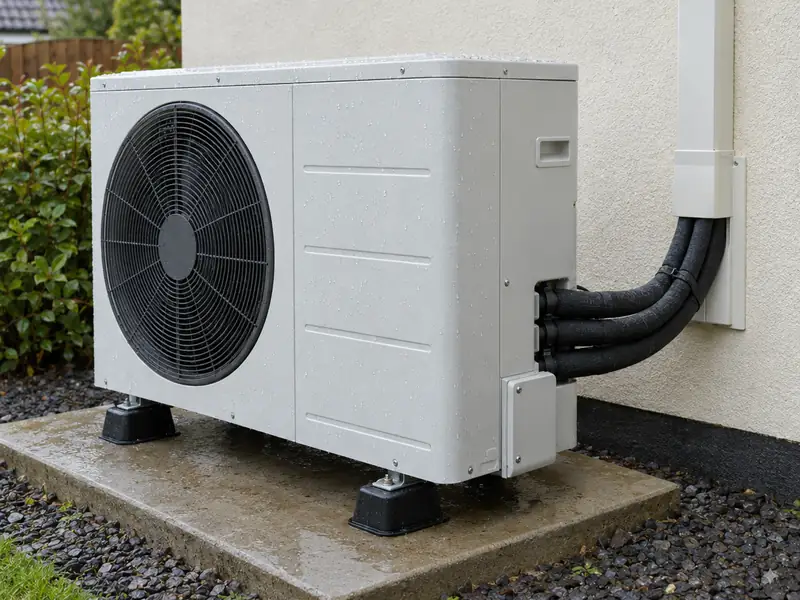
The trade-off is that the pipes between the outdoor unit and the house carry water, so they must be protected from freezing. That is done with glycol (an anti-freeze) in the system or with anti-freeze valves that release water from the outdoor pipework if it nears freezing, for example during a power cut in cold weather. Keeping the outdoor pipe run short and well insulated also helps efficiency.
For Rutland terraces with small yards, the survey confirms the unit fits with the clearances it needs. A survey in Rutland checks the unit position, pipe route and clearance zones together for homes across Rutland. Bungalows in Rutland often let the unit sit right beside the plant cupboard, keeping water pipes short.
Who it suits
- Owners who want the simplest installation, with no indoor refrigerant
- Homes where the unit can sit within a short pipe run of the cylinder
- Houses and bungalows with outdoor space close to where pipes enter the home
- Households that want to keep refrigerant work out of routine servicing
Grants and rules for heat pumps in England
Homes in Rutland can use the Boiler Upgrade Scheme, which takes £7,500 off the cost of an air source heat pump when it replaces fossil-fuel or electric heating. Replacing oil or LPG heating qualifies for £9,000 for installations from 21 July 2026 to 31 March 2027, and air-to-air systems for £2,500. The MCS-certified installer named in your quote applies for the grant and deducts it from the price.
Installing heat pumps is zero-rated for VAT across the UK until 31 March 2027. Since 29 May 2025, permitted development in England allows up to two air source heat pumps on a house, each up to 1.5 m³, with no blanket 1 m boundary rule — the installation must still meet the MCS planning standards, including the noise check. Listed buildings, flats and some conservation-area positions need extra consent, which we check at survey.
Monobloc heat pumps prices in Rutland
Here are typical prices for monobloc heat pumps in Rutland, installed and including VAT. Use the guide price tool for a figure based on your home, then a survey confirms it in writing.
| Home | Typical size | Installed guide price | After £7,500 grant |
|---|---|---|---|
| 1–2 bedroom flat or small terrace | 4–5 kW | £9,500–£12,500 | £2,000–£5,000 |
| 2–3 bedroom terrace or semi | 5–7 kW | £10,500–£13,500 | £3,000–£6,000 |
| 3 bedroom semi or small detached | 6–9 kW | £12,000–£15,500 | £4,500–£8,000 |
| 4 bedroom detached | 8–12 kW | £14,000–£18,000 | £6,500–£10,500 |
| 5+ bedroom or larger older house | 11–16 kW | £16,500–£22,500 | £9,000–£15,000 |
Installed, inc VAT: unit, cylinder, controls, minor pipework and commissioning.
Towns we cover in Rutland
We cover 2 towns in Rutland for monobloc heat pumps. Each links to local guide prices and the grant position for England.
| Town | Postcode district | Nearest town | Midwinter daylight |
|---|---|---|---|
| Oakham | LE15 | Uppingham | 7 h 37 min |
| Uppingham | LE15 | Oakham | 7 h 38 min |
Monobloc heat pumps questions
Are monobloc heat pumps covered by grants?
Yes. Monobloc units are air-to-water heat pumps, so in England and Wales they are covered by the Boiler Upgrade Scheme grant of £7,500 for eligible homes, or £9,000 when replacing oil or LPG heating within the published dates. In Scotland, Home Energy Scotland funding requires an MCS-certified installer and products. There is no dedicated homeowner heat pump grant in Northern Ireland at present.
Do monobloc heat pumps need an F-gas engineer?
For a typical installation no refrigerant work is needed on site, because the refrigerant circuit is sealed in the outdoor unit at the factory. That is one reason monobloc installs are simpler. If the sealed circuit ever develops a fault or leak, any repair to it must be done by an F-gas certified engineer, as with every refrigerant system.
How far can a monobloc unit be from the house?
Usually as close as practical, because water pipes outside lose heat and need frost protection. Manufacturers set limits on pipe length and size, and longer runs need larger, better-insulated pipes. Most homes site the unit against or near an outside wall close to where the pipes enter. If the only good position is far from the house, a split system may suit better.
Is glycol or anti-freeze valves the better option?
Neither is right for every home. Glycol gives reliable frost protection without draining but slightly reduces efficiency and needs its concentration checked at servicing. Anti-freeze valves keep the system water plain but release water if pipes near freezing during a power cut, so the system then needs refilling. The installer recommends one based on the unit, pipe run and how exposed the site is.