
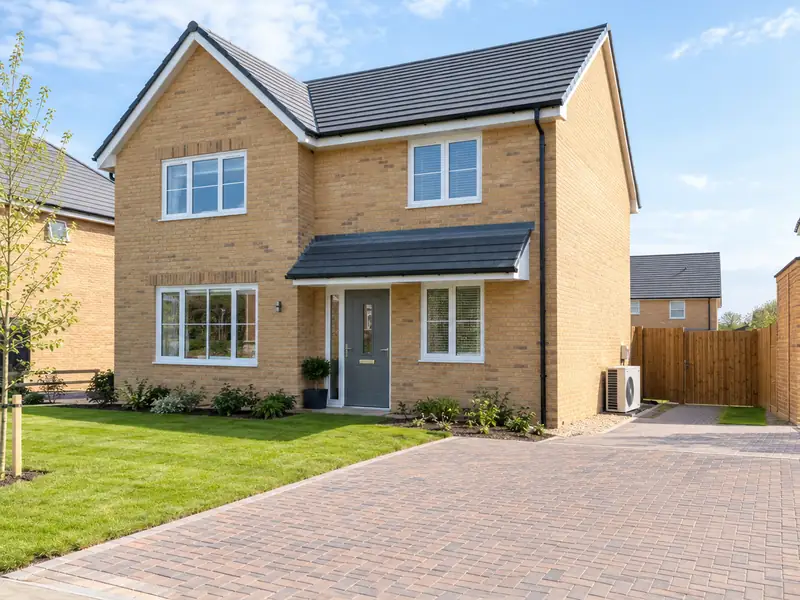
New homes in England are being built to tighter carbon standards, and Wales, Scotland and Northern Ireland each set their own building regulations; a heat pump is one of the main ways new homes meet them. We work from your architect's drawings and energy assessment, then fit in with the build programme: first-fix pipework before floors and walls are finished, and the outdoor unit, cylinder and controls once the building is weathertight.
For barn conversions and replacement dwellings near Glasgow and Dunbartonshire, the design starts from the specification of the new walls, floors and glazing. Builders working across Glasgow and Dunbartonshire can coordinate first and second fix with an installer covering Glasgow and Dunbartonshire. New homes in Glasgow and Dunbartonshire designed with underfloor heating downstairs get a low flow temperature that suits a heat pump.
Who it suits
- Small builders and developers working on one-off homes or small groups
- Replacement dwellings and major conversions treated as new homes
- Architects and builders who want a heat loss design from the drawings
- Self-builders planning heating alongside the structure
Grants and rules for heat pumps in Scotland
In Scotland, heat pump funding comes through Home Energy Scotland rather than the Boiler Upgrade Scheme: a grant of up to £7,500 (up to £1,500 extra for eligible rural and island homes) and an optional interest-free loan of up to £7,500. For a home in Glasgow and Dunbartonshire, apply and receive the written offer before the installation date is fixed.
Installing heat pumps is zero-rated for VAT across the UK until 31 March 2027. Scotland has its own permitted development rules for air source heat pumps and its own building standards, so we confirm what applies to your property at survey.
New-build and self-build heat pumps prices in Glasgow and Dunbartonshire
The ranges below are typical installed prices for homes in Glasgow and Dunbartonshire, including VAT. A survey sets the exact figure, because two similar-looking houses in Glasgow and Dunbartonshire can need quite different radiators and pipework.
| Home | Typical size | Installed guide price |
|---|---|---|
| 1–2 bedroom flat or small terrace | 4–5 kW | £9,500–£12,500 |
| 2–3 bedroom terrace or semi | 5–7 kW | £10,500–£13,500 |
| 3 bedroom semi or small detached | 6–9 kW | £12,000–£15,500 |
| 4 bedroom detached | 8–12 kW | £14,000–£18,000 |
| 5+ bedroom or larger older house | 11–16 kW | £16,500–£22,500 |
Installed, inc VAT: unit, cylinder, controls, minor pipework and commissioning. Most new builds are not eligible for grant funding, so no deduction is shown.
Towns we cover in Glasgow and Dunbartonshire
We cover 8 towns in Glasgow and Dunbartonshire for new-build and self-build heat pumps. Each links to local guide prices and the grant position for Scotland.
| Town | Postcode district | Nearest town | Midwinter daylight |
|---|---|---|---|
| Glasgow | G2 | Bishopbriggs | 6 h 59 min |
| Bearsden | G61 | Milngavie | 6 h 58 min |
| Clydebank | G81 | Bearsden | 6 h 58 min |
| Bishopbriggs | G64 | Glasgow | 6 h 58 min |
| Dumbarton | G82 | Alexandria | 6 h 57 min |
| Kirkintilloch | G66 | Bishopbriggs | 6 h 58 min |
| Alexandria | G83 | Dumbarton | 6 h 57 min |
| Milngavie | G62 | Bearsden | 6 h 58 min |
New-build and self-build heat pumps questions
How long does a new-build heat pump installation take?
It is split across the build. First fix typically takes a few days once the structure is up, and second fix with commissioning takes a few more days near completion. Underfloor heating in screed then follows a gradual drying-out schedule. Exact timing depends on your build programme, which we agree with your builder so trades are not left waiting on each other.
Do new builds have to have a heat pump?
The rules depend on the nation and when your project was approved, so check with your architect or building control. New homes in England are being built to tighter carbon standards, and Wales, Scotland and Northern Ireland set their own building regulations. A heat pump is one of the main ways new homes meet these standards, and we design the heating to whichever applies.
When do you need to be involved in a new build?
Ideally before the drawings are finalised, so the plant space, outdoor unit position and emitters are agreed with your architect. At the latest, the design should be done before first fix, when pipework goes in under floors and inside walls. Late involvement usually means compromises, such as a cylinder in an awkward space or pipe runs boxed in afterwards.
Where should the outdoor unit go on a new build?
Somewhere with free airflow, a solid base and drainage, away from bedroom windows and boundaries where possible, and positioned to pass the MCS noise assessment. On a new build this can be planned into the landscaping, such as a side return or screened area near the plant room, which keeps pipe runs short. Planning rules differ by nation, so we check the position at design stage.