
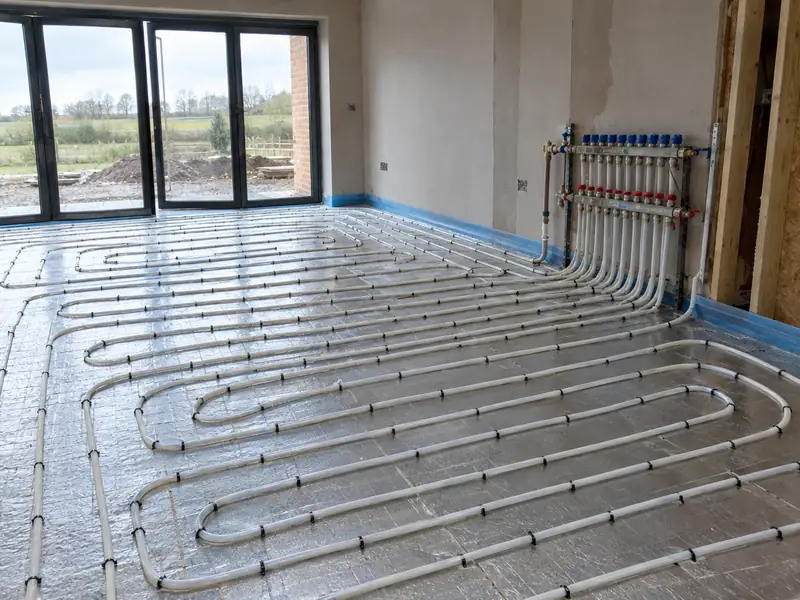
Underfloor heating can cover one room, an extension or the whole ground floor, and it works alongside radiators upstairs. We design it from the same room-by-room heat loss figures as the rest of the system, set out pipe spacing and zones for each room, and confirm which floor finishes will let the heat through.
Kitchen extensions in Powys are often the natural place to add underfloor heating when a heat pump goes in. We coordinate with builders working in Powys so underfloor pipes are laid and tested before the screed goes down. Homeowners in Powys and across Powys can mix underfloor heating downstairs with radiators upstairs on one heat pump.
Who it suits
- Self-builds and new floors where insulation and screed are going in anyway
- Ground floors being dug out or relaid as part of wider building work
- Extensions, especially open-plan kitchen-diners with large glazed areas
- Rooms where wall space for radiators is scarce
Grants and rules for heat pumps in Wales
In Wales the Boiler Upgrade Scheme gives £7,500 towards an air source heat pump (£9,000 if it replaces oil or LPG, from 21 July 2026 to 31 March 2027; £2,500 for air-to-air). The MCS-certified installer named in your quote applies to Ofgem for you, and the grant comes off your quote.
There is no VAT on installing a heat pump anywhere in the UK, Wales included, until 31 March 2027. Planning rules for heat pumps in Wales are set by the Welsh Government and differ from England's, so the surveyor checks the unit position against them.
Underfloor heating with heat pumps prices in Powys
These are guide prices for Powys, installed and including VAT. Your final price is fixed in a written quote after the survey and depends on the heat loss of the house, the radiators that need changing and where the unit goes.
| Work | Guide price |
|---|---|
| Wet underfloor heating, one room | £1,500–£3,500 |
| Wet underfloor heating, whole ground floor | £5,000–£15,000 |
Installed, inc VAT. Floor finishes and screed drying time are confirmed at survey.
Towns we cover in Powys
We cover 10 towns in Powys for underfloor heating with a heat pump. Each links to local guide prices and the grant position for Wales.
| Town | Postcode district | Nearest town | Midwinter daylight |
|---|---|---|---|
| Brecon | LD3 | Crickhowell | 7 h 45 min |
| Builth Wells | LD2 | Llandrindod Wells | 7 h 43 min |
| Crickhowell | NP8 | Abergavenny | 7 h 46 min |
| Hay-on-Wye | HR3 | Builth Wells | 7 h 44 min |
| Knighton | LD7 | Newtown | 7 h 41 min |
| Llandrindod Wells | LD1 | Builth Wells | 7 h 42 min |
| Machynlleth | SY20 | Dolgellau | 7 h 38 min |
| Newtown | SY16 | Welshpool | 7 h 39 min |
| Welshpool | SY21 | Newtown | 7 h 37 min |
| Ystradgynlais | SA9 | Pontardawe | 7 h 47 min |
Underfloor heating with a heat pump questions
Can I heat just one room with underfloor heating?
Yes. A single room, such as a kitchen extension, can have its own underfloor zone connected to the heat pump alongside the radiators in the rest of the house. It needs its own thermostat and a manifold, which for one room can be compact. The design checks the room's heat loss so the floor can meet it at the system's flow temperature.
How much does underfloor heating cost with a heat pump?
Wet underfloor heating for a whole ground floor has a guide price of £5,000–£15,000, installed and including VAT, and a single room has a guide price of £1,500–£3,500. The spread reflects floor type, area, whether an overlay or screed system is used and how much floor preparation is needed. Your written quote fixes the price after the survey.
Can I put carpet over underfloor heating?
Yes, as long as the carpet and underlay together have a low tog rating, which measures how much they resist heat. For heat pump systems a combined figure of around 1.5 tog or less is a common target. Thick carpet on heavy underlay can cut output noticeably, so rooms with carpet may need closer pipe spacing.
How long does a screed floor take before I can use the heating?
Screed needs to dry before the heating is used at full temperature and before most floor finishes are laid. Drying time depends on the screed type, depth and conditions, from around a week for some liquid screeds to several weeks or more for traditional sand and cement. The heating is then brought up gradually over several days to avoid cracking.