
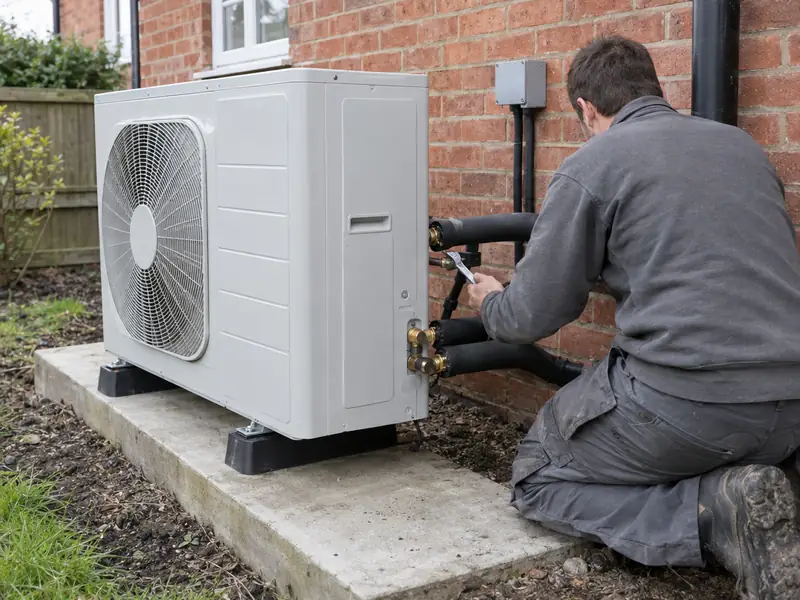
Installing an air source heat pump follows a set sequence: enquiry, home survey and heat loss calculation, system design and written quote, grant application, installation, then commissioning, handover and registration. A typical home installation takes 2–4 days on site, and longer if radiators or pipework are changed.
This guide walks through each stage, what you need to do and what to expect in your first winter. Timings are typical and depend on your home, the equipment and, where a grant is involved, the scheme's own process.
What are the stages of a heat pump installation?
There are six main stages, from first enquiry to a registered, working system.
| Stage | What happens | Typical timing |
|---|---|---|
| 1. Enquiry | You share basic details about your home and current heating | A short call or online form |
| 2. Survey | A free home survey and room-by-room heat loss calculation | Usually 1–3 hours at your home |
| 3. Design and quote | System design and a written quote naming the MCS-certified installer | Typically a week or two after the survey |
| 4. Grant | Grant application, depending on where you live | Varies by nation and scheme |
| 5. Installation | Outdoor unit, cylinder, controls, pipework and electrics fitted | Typically 2–4 days on site, longer with radiator or pipework changes |
| 6. Commissioning and handover | System tested, set up, explained to you and registered | Usually the final day, with paperwork to follow |
What happens at the enquiry stage?
The enquiry is a short first conversation to check that a heat pump is worth surveying for and to gather the details the surveyor needs.
Expect questions about the type and age of your home, the number of bedrooms, your current heating and fuel, any recent insulation work and where you live. Photos of your boiler, radiators and the outside space you have in mind are useful. In England and Wales you will also be asked whether the home has had heat pump funding before, because that affects grant eligibility.
You can get a rough idea of cost at this stage from the guide prices, such as £12,000–£15,500 installed including VAT for a three-bedroom home before any grant, but your actual price comes after the survey.
What happens during the survey and heat loss calculation?
The survey is a free visit to your home, for installation enquiries, where the surveyor measures each room and works out how much heat your home loses so the heat pump can be sized correctly.
The heat loss calculation follows the MCS method, room by room. It takes account of the size of each room, the wall, floor and roof construction, insulation, windows and the temperature you want in each space. From this the surveyor works out the size of heat pump needed and whether your radiators can deliver enough heat at a low flow temperature.
The surveyor also looks at where the outdoor unit could go, the pipe route, space for a hot water cylinder, your electrical supply and fuse board, and any planning points. In England most houses fall under permitted development, subject to the MCS standards including a noise assessment; in Wales, Scotland and Northern Ireland we check what applies at survey. See the heat loss survey page.
What is in the design and written quote?
The written quote sets out the system designed for your home, the full price including VAT, any grant deducted and the name of the MCS-certified installer for your job.
- The heat pump model and size, with its expected seasonal efficiency
- The hot water cylinder and controls
- Any radiators or pipework being changed, room by room
- Where the outdoor unit and cylinder will go
- The grant deducted, where one applies, and the balance you pay
- Manufacturer warranties, which pass to you and vary by make and model, and our workmanship guarantee in writing
- Payment terms and an expected timetable
Nothing is ordered until you accept the written quote. Your rights under the Consumer Rights Act 2015 and the Consumer Contracts Regulations 2013 apply, including the right to cancel within 14 days if you agree the contract away from our premises; if you ask us to start sooner and then cancel, you pay only for work done up to that point. Across the UK the installation of a heat pump is zero-rated for VAT until 31 March 2027.
How does the grant application work in each nation?
How the grant is applied for depends on where you live: in England and Wales the installer applies for you, while in Scotland you apply through Home Energy Scotland and must have a written offer before work starts.
- England and Wales. The Boiler Upgrade Scheme gives £7,500 towards an air source heat pump, or £9,000 when it replaces oil or LPG heating and is installed between 21 July 2026 and 31 March 2027. The MCS-certified installer applies to Ofgem and deducts the grant from your quote, and Ofgem contacts you to confirm.
- Scotland. Home Energy Scotland offers a grant of up to £7,500, up to £1,500 more for eligible rural and island homes, and an optional interest-free loan of up to £7,500. The installation date is set once your written funding offer arrives.
- Northern Ireland. There is no dedicated heat pump grant for homeowners at present. Heat pumps have sometimes been funded through the Northern Ireland Sustainable Energy Programme, so it is worth asking.
The grants by nation guide has more detail on each scheme.
What happens on installation days?
A typical home installation takes 2–4 days on site, and longer if radiators or pipework are being replaced.
A common sequence is: protecting floors and preparing work areas; fitting the base and outdoor unit; removing the old boiler, where agreed, and fitting the new cylinder; running pipework between the unit and the house; changing radiators or pipework where the design needs it; and making the electrical connection. Your heating and hot water may be off for part of the time, and you are told when in advance.
Where required, the installer notifies the electricity network operator, the company that runs the local power network, about the new heat pump. This is handled for you as part of the job.
What happens at commissioning and handover?
Commissioning is the final stage, where the installer fills, tests and sets up the system, then shows you how to use it.
The engineer checks for leaks, sets system pressure, sets the weather compensation curve and hot water schedule, and checks that the heat pump runs as designed. At handover you should be shown the controls, how to check system pressure, what the outdoor unit does during a defrost and who to call with questions. You should also receive the manuals and commissioning records.
The installer then registers the installation with MCS and issues an MCS certificate. Keep it safe: it is needed for grant claims and is useful when you sell your home, because it shows the system was designed and installed to the MCS standard.
What should I expect in my first winter?
In your first winter, expect the heat pump to run for longer periods at a lower temperature than a boiler, with radiators that feel warm rather than hot.
- Leave the heating on rather than switching it off and on
- Give the system a few days to settle after any change to settings
- Expect occasional defrosts in cold, damp weather, with a little vapour from the unit
- Keep the outdoor unit clear of leaves and snow
- Note any rooms that feel too cool or too warm, so the heating curve can be fine-tuned
- Check the system pressure now and then, as you were shown at handover
Arrange the first annual service around 12 months after installation, as servicing is often a condition of the manufacturer's warranty. The controls and tariffs guide has more on settings.
Questions
How long does a heat pump installation take?
A typical home installation takes 2–4 days on site, longer if radiators or pipework are changed. From first enquiry to a working system usually takes several weeks, depending on the survey date, equipment availability and, in Scotland, the wait for a written Home Energy Scotland offer before work starts. Timings are typical and set out in your quote.
Will I be without heating during the installation?
You may be without heating and hot water for part of the installation, usually while the old boiler is removed and the new system is connected. The work is planned to keep this as short as practical, and you are told in advance. If anyone in the home is vulnerable, mention it at survey so temporary heating can be discussed.
Do I have to pay for the survey?
No. The home survey and heat loss calculation are free for installation enquiries. If you only want a stand-alone heat loss survey and report, without an installation, that is a paid service with a guide price of £150–£400 including VAT. Servicing and repair visits are also charged separately.
What paperwork will I receive?
At the end of the installation you should receive the commissioning records, manuals for the heat pump, cylinder and controls, details of the manufacturer warranties and our written workmanship guarantee, and an MCS certificate once the installation is registered. Keep these together, as they may be needed for warranty claims and when you sell your home.
Sources
- Apply for the Boiler Upgrade Scheme – GOV.UK
- MCS (Microgeneration Certification Scheme)
- Home Energy Scotland
- Air source heat pumps – Energy Saving Trust
Scheme figures and price cap rates checked October 2026.