
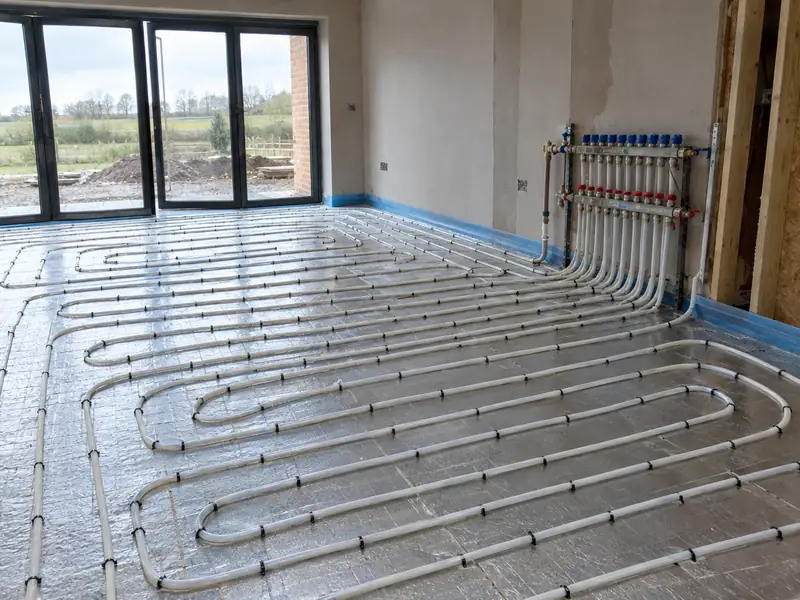
There are two main ways to fit it. In new floors, such as an extension or a ground floor being dug out, pipes are set into a screed: a layer of sand and cement, or a flowing liquid mix, laid over insulation. In existing rooms, a low-profile or overlay system uses thin grooved boards laid on top of the current floor, raising it by a modest amount instead of breaking it up.
Every underfloor design for the Scottish Borders starts with the floor finish you plan to lay, from tiles to carpet. For homes in the Scottish Borders with solid ground floors, a low-profile overlay system can avoid breaking up the existing floor. Kitchen extensions in the Scottish Borders are often the natural place to add underfloor heating when a heat pump goes in.
Who it suits
- Ground floors being dug out or relaid as part of wider building work
- Homeowners who want even, gentle warmth with no radiators on show
- Rooms where wall space for radiators is scarce
- Self-builds and new floors where insulation and screed are going in anyway
Grants and rules for heat pumps in Scotland
In Scotland, heat pump funding comes through Home Energy Scotland rather than the Boiler Upgrade Scheme: a grant of up to £7,500 (up to £1,500 extra for eligible rural and island homes) and an optional interest-free loan of up to £7,500. For a home in the Scottish Borders, apply and receive the written offer before the installation date is fixed.
Installing heat pumps is zero-rated for VAT across the UK until 31 March 2027. Scotland has its own permitted development rules for air source heat pumps and its own building standards, so we confirm what applies to your property at survey.
Underfloor heating with heat pumps prices in the Scottish Borders
These are guide prices for the Scottish Borders, installed and including VAT. Your final price is fixed in a written quote after the survey and depends on the heat loss of the house, the radiators that need changing and where the unit goes.
| Work | Guide price |
|---|---|
| Wet underfloor heating, one room | £1,550–£3,550 |
| Wet underfloor heating, whole ground floor | £5,100–£15,300 |
Installed, inc VAT. Floor finishes and screed drying time are confirmed at survey.
Towns we cover in the Scottish Borders
We cover 8 towns in the Scottish Borders for underfloor heating with a heat pump. Each links to local guide prices and the grant position for Scotland.
| Town | Postcode district | Nearest town | Midwinter daylight |
|---|---|---|---|
| Duns | TD11 | Eyemouth | 7 h 00 min |
| Eyemouth | TD14 | Duns | 6 h 58 min |
| Galashiels | TD1 | Selkirk | 7 h 02 min |
| Hawick | TD9 | Selkirk | 7 h 04 min |
| Jedburgh | TD8 | Kelso | 7 h 04 min |
| Kelso | TD5 | Jedburgh | 7 h 02 min |
| Peebles | EH45 | Penicuik | 7 h 01 min |
| Selkirk | TD7 | Galashiels | 7 h 03 min |
Underfloor heating with a heat pump questions
Is underfloor heating better than radiators with a heat pump?
Underfloor heating usually allows a lower flow temperature than radiators, which helps a heat pump run efficiently. That does not make radiators a poor choice: correctly sized radiators also work well, and they are far less disruptive to fit in existing rooms. Many homes use underfloor heating in an extension or on the ground floor and radiators elsewhere.
Can I heat just one room with underfloor heating?
Yes. A single room, such as a kitchen extension, can have its own underfloor zone connected to the heat pump alongside the radiators in the rest of the house. It needs its own thermostat and a manifold, which for one room can be compact. The design checks the room's heat loss so the floor can meet it at the system's flow temperature.
How much does underfloor heating cost with a heat pump?
Wet underfloor heating for a whole ground floor has a guide price of £5,000–£15,000, installed and including VAT, and a single room has a guide price of £1,500–£3,500. The spread reflects floor type, area, whether an overlay or screed system is used and how much floor preparation is needed. Your written quote fixes the price after the survey.
Can I put carpet over underfloor heating?
Yes, as long as the carpet and underlay together have a low tog rating, which measures how much they resist heat. For heat pump systems a combined figure of around 1.5 tog or less is a common target. Thick carpet on heavy underlay can cut output noticeably, so rooms with carpet may need closer pipe spacing.